
Which German Phrases Do You Need for the B2 Speaking Exam?
The speaking component of the German B2 exam is where many learners feel the most pressure. Unlike written tasks, there is no time to look up a word or rephrase a sentence quietly. Everything happens in real time, in front of an examiner, and the quality of your language use matters just as much as what you actually say. The good news is that preparing specific phrases and structures in advance makes a significant difference. Knowing what to say when you want to introduce a point, challenge an argument, or buy yourself a moment to think can be the difference between a confident performance and a fumbled one.
This guide covers the key German phrases for B2 level that will help you navigate every part of the oral exam with more control and precision. Whether you are preparing for the Goethe B2 speaking exam, the telc B2 German speaking test, or another recognized certification, the language strategies here apply across formats.
How the B2 Speaking Exam Is Structured
The B2 oral exam typically consists of two main parts: a prepared or semi-prepared monologue and an interactive discussion with the examiner or a second candidate. The exact format varies slightly depending on the institution. In the Goethe B2 exam, candidates present a topic and then engage in a discussion. The telc B2 format similarly combines individual presentation with a collaborative or examiner-led dialogue.
Examiners assess several criteria simultaneously: fluency, range of vocabulary, grammatical accuracy, coherence, and the ability to interact naturally. This means performing well is not just about knowing the right words but about demonstrating that you can organize your thoughts, respond to prompts, and sustain a conversation at a level appropriate to B2. Understanding the structure in advance allows you to prepare targeted language for each phase rather than trying to improvise everything on the day.
In the following video, you’ll see exactly what both parts of the Goethe B2 speaking exam look like. You’ll watch a full model presentation and a model discussion, plus 25 phrases you can use in any B2 oral exam.
Phrases for Presenting and Structuring a Monologue
A well-structured monologue signals to the examiner that you can organize ideas coherently. Opening your presentation with a clear framing sentence sets a strong tone immediately.
Useful phrases for opening and structuring include:
- Ich möchte heute über … sprechen. (I would like to talk about … today.)
- Zunächst möchte ich … erläutern. (First, I would like to explain …)
- Im Folgenden werde ich … darstellen. (In the following, I will present …)
- Auf der einen Seite … auf der anderen Seite … (On the one hand … on the other hand …)
- Abschließend lässt sich sagen, dass … (To conclude, it can be said that …)
- Meiner Meinung nach … (In my opinion …)
- Es ist wichtig zu betonen, dass … (It is important to emphasize that …)
Connectors and discourse markers are particularly valued at B2 level because they show you can link ideas rather than just list them. Words like darüber hinaus (furthermore), dennoch (nevertheless), and infolgedessen (as a result) elevate the register of your speech noticeably.
Expressions for Discussion and Argumentation

The discussion phase tests your ability to engage with another person’s ideas, defend a position, and respond to counterarguments. This is where many learners lose marks by either agreeing too readily or struggling to push back politely.
Phrases that help you engage constructively in a discussion:
- Das sehe ich etwas anders. (I see that a little differently.)
- Ich stimme Ihnen teilweise zu, aber … (I partly agree with you, but …)
- Das ist ein guter Punkt, allerdings … (That is a good point, however …)
- Man könnte auch argumentieren, dass … (One could also argue that …)
- Ich bin der Meinung, dass … (I am of the opinion that …)
- Hinzu kommt, dass … (Added to this is the fact that …)
- Das hängt davon ab, ob … (That depends on whether …)
Aim to develop your points rather than simply stating them. Giving a brief reason or example after each claim shows the examiner that you can build an argument, not just state a position.
Language for Handling Unknown Vocabulary Mid-Exam
Every B2 candidate will encounter a moment where the exact word does not come to mind. How you handle that moment matters. Stopping abruptly or switching to English will cost marks, but having a set of circumlocution and filler strategies ready means you can keep the conversation moving.
Practical phrases for managing vocabulary gaps:
- Ich meine das Wort für … wenn man … (I mean the word for … when you …)
- Wie sagt man das auf Deutsch? Es ist so etwas wie … (How do you say that in German? It is something like …)
- Das ist eine Art von … (That is a kind of …)
- Ich bin mir nicht sicher, wie man das nennt, aber es geht um … (I am not sure what it is called, but it is about …)
- Moment, ich überlege kurz. (Just a moment, I am thinking.)
These strategies demonstrate communicative competence, which is itself part of what B2 oral exams assess. An examiner would much rather hear you describe a concept in your own words than watch you go silent for thirty seconds.
Common Mistakes That Cost Marks in the B2 Oral
Awareness of common errors is part of solid B2 German exam preparation. Several patterns appear repeatedly in candidate performances and are worth addressing directly in your practice.
The most frequent issues include:
- Speaking too fast under pressure. Speed often increases with nerves, which reduces clarity and increases errors. Deliberate pacing is a skill worth training.
- Using only simple sentence structures. B2 requires complex grammar. Relative clauses, subjunctive mood (Konjunktiv II), and passive constructions should appear naturally in your speech.
- Giving one-sentence answers. Short responses do not demonstrate range. Develop each point with a reason or example.
- Avoiding difficult topics. Steering the conversation toward only comfortable vocabulary limits the examiner’s ability to assess your full range.
- Neglecting discourse markers. Jumping from point to point without connectors makes speech sound disjointed and harder to follow.
Recording yourself during practice is one of the most effective ways to catch these habits before the exam. What feels fluent in the moment often sounds quite different on playback.
How to Practise These Phrases Before Exam Day
Knowing a phrase passively and being able to use it under pressure are very different things. Active, repeated production is what moves language from recognition into genuine fluency.
Effective practice approaches include:
- Shadowing audio content at B2 level to internalize natural rhythm and phrasing.
- Recording short monologues on current topics and reviewing them for structure and connector use.
- Practising with a speaking partner who can give genuine pushback in the discussion phase.
- Drilling specific phrase sets by writing them out, then using them in spoken sentences without looking.
- Simulating timed exam conditions regularly, including the pressure of speaking without preparation time.
Consistency matters more than intensity. Short, focused practice sessions spread across several weeks will build more reliable fluency than a few long cramming sessions close to the exam date.
How lingoni Supports Your German B2 Speaking Exam Preparation
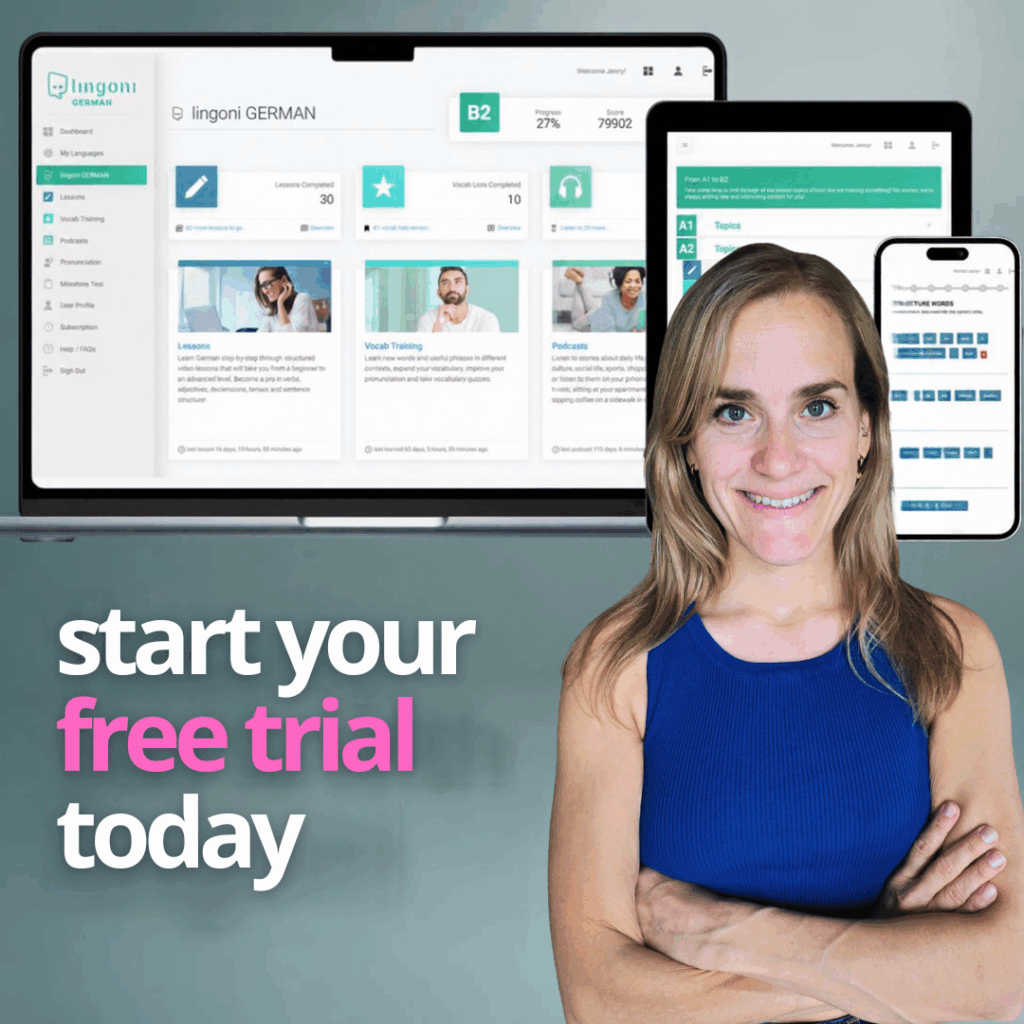
We built lingoni specifically for learners who want structured, self-directed progress from A1 all the way through B2. For the speaking exam in particular, here is what we offer:
- One structured learning path per level where you select your level, for example B2, and work through video lessons, podcasts, worksheets and quizzes in the intended order.
- Completely revised worksheets that now include exercises based on common exam formats such as telc and Goethe, so you can practise the language and task types you will meet on exam day.
- Listening and speaking tasks integrated into lessons to build active production skills, not just passive recognition.
- Milestone Tests at the end of each level that serve as a genuine self-check before you unlock the next stage.
- Flexible subscription options with a monthly plan you can cancel at any time, as well as annual and Lifetime options, plus a 7-day free trial.
If you are working toward the Goethe B2 speaking exam or the telc B2 German speaking test in 2026, structured preparation makes the difference. Explore our German learning programme and start building the speaking confidence you need at lingoni German.