

What German should you learn before your first day at a new job?
Starting a new job is nerve-wracking enough without the added pressure of doing it in a second language. If you are moving to Germany or Austria, or joining a German-speaking team anywhere in the world, knowing a handful of the right words and phrases before day one can make a real difference. You do not need to be fluent. You need to be functional, confident, and ready to communicate the basics. Here is exactly what to focus on.
What German do you actually need on your first day at work?
On your first day at a German-speaking workplace, you need enough German vocabulary to handle introductions, follow basic instructions, ask for help politely, and navigate small talk. You do not need perfect grammar. You need a working set of phrases that cover the most common situations you will face in the first few hours.
Think about what actually happens on a first day: you meet colleagues, you get shown around the office, someone explains your schedule, and you probably sit through a short onboarding session. The German you need for all of this falls into a few clear categories:
- Greeting and introducing yourself
- Saying you are new and still learning German
- Asking people to speak more slowly or repeat themselves
- Understanding basic workplace directions and instructions
- Navigating small talk over coffee or lunch
You do not need B2-level German to survive day one. But having A2 to B1 foundations in place will help you feel far less lost and far more approachable to your new colleagues.
What are the most important German phrases for workplace introductions?

The most important German phrases for new job introductions are those that tell people who you are, where you are from, and what your role is. A few well-rehearsed sentences go a long way in making a confident first impression, even if your German is still a work in progress.
Here are the phrases worth learning before you walk through the door:
- Guten Morgen, ich bin [Name]. (Good morning, I am [Name].)
- Ich fange heute hier an. (I am starting here today.)
- Ich komme aus [Land]. (I am from [country].)
- Ich arbeite als [Berufsbezeichnung]. (I work as a [job title].)
- Ich lerne noch Deutsch, aber ich gebe mein Bestes. (I am still learning German, but I am doing my best.)
- Es freut mich, Sie/dich kennenzulernen. (Nice to meet you.)
That last phrase is worth noting: in a professional setting, Germans often use Sie (formal you) rather than du (informal you) until a colleague suggests switching. When in doubt, default to Sie with people you have just met at work.
How do you ask for help or clarification in German at work?
To ask for help or clarification in German at work, use polite, direct phrases that signal you did not understand something or need guidance. Germans generally appreciate directness, so asking clearly is better than nodding along and hoping for the best.
These phrases cover the situations you will run into most often:
- Können Sie das bitte wiederholen? (Could you please repeat that?)
- Können Sie bitte langsamer sprechen? (Could you please speak more slowly?)
- Ich habe das nicht ganz verstanden. (I did not quite understand that.)
- Was bedeutet [Wort]? (What does [word] mean?)
- Können Sie mir helfen? (Can you help me?)
- Wie macht man das hier? (How do you do that here?)
Most colleagues will respect you more for asking than for staying silent and making avoidable mistakes. Saying Ich lerne noch Deutsch (I am still learning German) upfront also sets realistic expectations and usually brings out the patient side of people around you.
What German vocabulary should you learn for emails and written communication?
For German workplace emails, you need a core set of formal phrases for greetings, sign-offs, making requests, and responding to messages. Written German at work tends to be more formal than spoken German, so the vocabulary here is slightly different from what you would use in conversation.
Start with these building blocks:
- Sehr geehrte Damen und Herren, (Dear Sir or Madam, used when you do not know the recipient)
- Sehr geehrte Frau [Name] / Sehr geehrter Herr [Name], (Dear Ms / Mr [Name])
- Ich schreibe Ihnen bezüglich… (I am writing to you regarding…)
- Könnten Sie mir bitte mitteilen… (Could you please let me know…)
- Vielen Dank für Ihre Antwort. (Thank you for your reply.)
- Mit freundlichen Grüßen, (Kind regards, the standard professional sign-off)
Once you move into internal team communication, especially over tools like Slack or Teams, the tone often becomes much more casual. You will see Hi, Danke, and Bis bald (see you soon) used regularly. Pay attention to how your colleagues write to each other and mirror that level of formality.
How long does it take to feel confident speaking German at work?
Most adult learners who study consistently can reach a functional level of spoken confidence for workplace German within three to six months. The timeline depends on how much time you invest each week, your existing language background, and how much German you are exposed to in your daily environment.
Here is a realistic breakdown:
- After 4 to 6 weeks of regular study: You can handle introductions, basic small talk, and simple requests.
- After 3 months: You can follow meetings at a slower pace, write basic emails, and hold short conversations.
- After 6 months: You can participate more actively in team discussions, understand most written communication, and express your ideas clearly enough to do your job.
The single biggest accelerator is using German outside your study sessions. That means speaking with colleagues rather than defaulting to English, reading German emails carefully instead of skimming, and listening to German content in your downtime. Immersion does not require living in Germany full-time. It requires choosing German whenever you have the option.
Where should you start learning German for your new job?
The best place to start learning German for a new job is with structured, level-appropriate content that covers practical workplace vocabulary from the beginning. General language apps built around games and streaks rarely give you the professional vocabulary you need quickly. You want a course that moves you from basics to usable workplace German in a logical, measurable way.
How lingoni helps you learn German for work
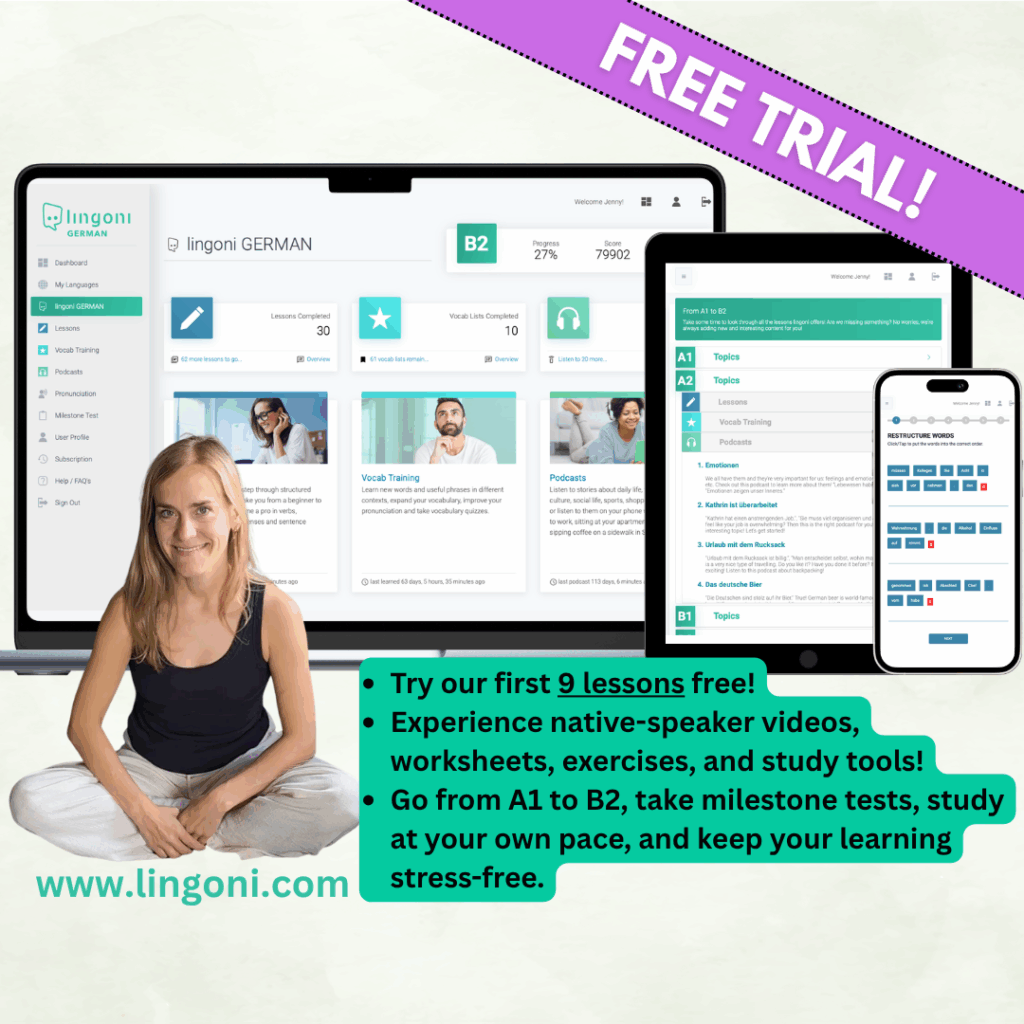
We built lingoni specifically for motivated adult learners who want real progress, not just a feel-good streak. Here is what the lingoni German course gives you when you are preparing for a new job in a German-speaking environment:
- Structured levels from A1 to B2, so you always know where you are and what comes next
- Videos, worksheets, podcasts, and interactive exercises covering reading, writing, listening, and speaking
- Milestone Tests at the end of each level, so you can prove to yourself that you have genuinely mastered the material before moving on
- Flexible, self-directed learning that fits around your work schedule, whether you have 20 minutes a day or a full hour
- Live online conversation courses in small groups, so you can practice speaking in a low-pressure setting before your first day
- Intermediate entry via Milestone Tests, so if you already know some German, you do not have to start from zero
If your first day is coming up soon and you want to make sure you arrive prepared, start with our German course and work through the level that matches where you are right now. The structure is there. You just have to show up and put in the work.