
What German phrases do you need for networking events?
Attending a networking event in Germany — or a German-speaking professional environment anywhere — can feel intimidating when you are still building your language skills. The good news is that networking conversations follow predictable patterns, and a solid set of German phrases for networking events will carry you through most situations with confidence. Whether you are an expat settling into a new city, a professional starting a new role, or simply someone who wants to make a strong impression at a business event, the phrases below will help you walk in prepared.
What German phrases do you need to introduce yourself at networking events?
The most important German phrases for introducing yourself at a networking event are those that cover your name, your role, and what you do. A clear, confident introduction sets the tone for everything that follows. Keep it short, direct, and conversational rather than rehearsed.
Here are the core phrases you need:
- Ich heiße [Name]. (My name is [Name].)
- Ich bin [Name]. (I am [Name].) — slightly more casual
- Ich arbeite bei [Unternehmen]. (I work at [company].)
- Ich bin [Berufsbezeichnung]. (I am a [job title].)
- Ich komme ursprünglich aus [Land/Stadt]. (I originally come from [country/city].)
- Ich bin seit [Zeitraum] in Deutschland. (I have been in Germany for [period of time].)
Mentioning where you are from often sparks a natural follow-up question and takes the pressure off you to drive the conversation forward. Germans tend to appreciate directness, so a concise, clear introduction is far better than an overly elaborate one.
How do you start a conversation with a stranger in German?

Starting a conversation with a stranger in German at a networking event works best with a simple, open-ended question or a comment about the event itself. You do not need a clever opener. A friendly, direct approach is both culturally appropriate and easy to execute even at an intermediate language level.
Try these conversation starters:
- Sind Sie auch zum ersten Mal hier? (Is this your first time here too?)
- Wie gefällt Ihnen die Veranstaltung? (How are you finding the event?)
- In welcher Branche sind Sie tätig? (What industry are you in?)
- Haben Sie den Vortrag vorhin gehört? (Did you catch the talk earlier?)
- Darf ich mich kurz vorstellen? (May I briefly introduce myself?)
Note the use of Sie (formal you) rather than du (informal you). In German professional settings, Sie is the default with strangers unless the other person explicitly suggests switching to du. Sticking with Sie shows respect and cultural awareness, which makes a strong first impression.
What are the most useful German phrases for exchanging contact details?
The most useful German phrases for exchanging contact details at a networking event are those that request or offer a business card, a LinkedIn connection, or a follow-up meeting. These phrases are short and straightforward, and knowing them prevents an awkward silence at the end of a good conversation.
- Haben Sie eine Visitenkarte? (Do you have a business card?)
- Hier ist meine Visitenkarte. (Here is my business card.)
- Darf ich Ihnen meine Kontaktdaten geben? (May I give you my contact details?)
- Sind Sie auf LinkedIn? (Are you on LinkedIn?)
- Ich würde mich freuen, in Kontakt zu bleiben. (I would love to stay in touch.)
- Darf ich Ihnen eine E-Mail schicken? (May I send you an email?)
- Wir sollten uns mal auf einen Kaffee treffen. (We should meet for a coffee sometime.)
Exchanging details in German also signals genuine effort and commitment to the relationship, which is particularly appreciated in professional German culture where trust is built gradually.
How do you politely end a networking conversation in German?
To politely end a networking conversation in German, use a warm but clear closing phrase that signals you are wrapping up without making the other person feel dismissed. Germans value directness, so a clean, polite exit is perfectly acceptable and will not come across as rude.
- Es war sehr schön, Sie kennenzulernen. (It was really nice to meet you.)
- Ich muss mich leider verabschieden. (I am afraid I need to say goodbye.)
- Ich möchte noch kurz mit [Person] sprechen. (I would like to have a quick word with [person].)
- Ich freue mich auf unser nächstes Gespräch. (I look forward to our next conversation.)
- Schönen Abend noch! (Have a lovely evening!)
- Bis bald! (See you soon!)
A good closing phrase leaves a positive final impression. If you exchanged contact details, a brief mention of following up, such as Ich melde mich bei Ihnen (I will be in touch), reinforces that you mean what you said.
What German vocabulary do you need to talk about your job and industry?
To talk about your job and industry in German at a networking event, you need vocabulary covering your professional role, your sector, your responsibilities, and your goals. This is the area where many learners feel most unprepared, but a targeted set of professional German vocabulary goes a long way.
Job titles and roles
- der Ingenieur / die Ingenieurin (engineer)
- der Projektmanager / die Projektmanagerin (project manager)
- der Freiberufler / die Freiberuflerin (freelancer)
- der Selbstständige / die Selbstständige (self-employed person)
- der Geschäftsführer / die Geschäftsführerin (managing director / CEO)
Useful phrases for describing what you do
- Ich bin zuständig für [Bereich]. (I am responsible for [area].)
- Ich spezialisiere mich auf [Thema]. (I specialize in [topic].)
- Wir arbeiten hauptsächlich mit [Kunden/Unternehmen]. (We mainly work with [clients/companies].)
- Ich bin gerade dabei, [Projekt] aufzubauen. (I am currently building [project].)
- Mein Hintergrund liegt im Bereich [Branche]. (My background is in [industry].)
Knowing your own professional vocabulary in German is one of the most practical steps you can take before attending a German-language event. Write down your own job title, your company’s sector, and two or three sentences describing what you do, then practice saying them out loud until they feel natural.
How can you practice German networking phrases before an event?
The most effective way to practice German networking phrases before an event is to combine structured vocabulary learning with real speaking practice. Passive studying is not enough. You need to rehearse out loud, ideally in a context that mimics the pressure of a real conversation.
Here are practical ways to prepare:
- Write your own script. Draft a 60-second self-introduction in German. Include your name, your role, your industry, and one thing you are currently working on. Practice it until it flows naturally.
- Use role-play exercises. Practice with a language partner, tutor, or in a small group conversation class. Simulate the scenario of meeting someone new, exchanging details, and wrapping up the conversation.
- Focus on pronunciation. German pronunciation can trip up learners in high-pressure moments. Pay particular attention to words like Berufsbezeichnung (job title) or Veranstaltung (event) that you are likely to use.
- Learn vocabulary in context. Rather than memorizing isolated words, learn phrases in the context of a networking situation. This makes them easier to recall when you need them.
- Record yourself. Listening back to your own German helps you spot hesitations, mispronunciations, and gaps in your vocabulary before they happen in front of a real audience.
Consistent practice in the days leading up to an event, even just 15 to 20 minutes a day, makes a noticeable difference to your confidence in the room.
How lingoni helps you build German networking vocabulary
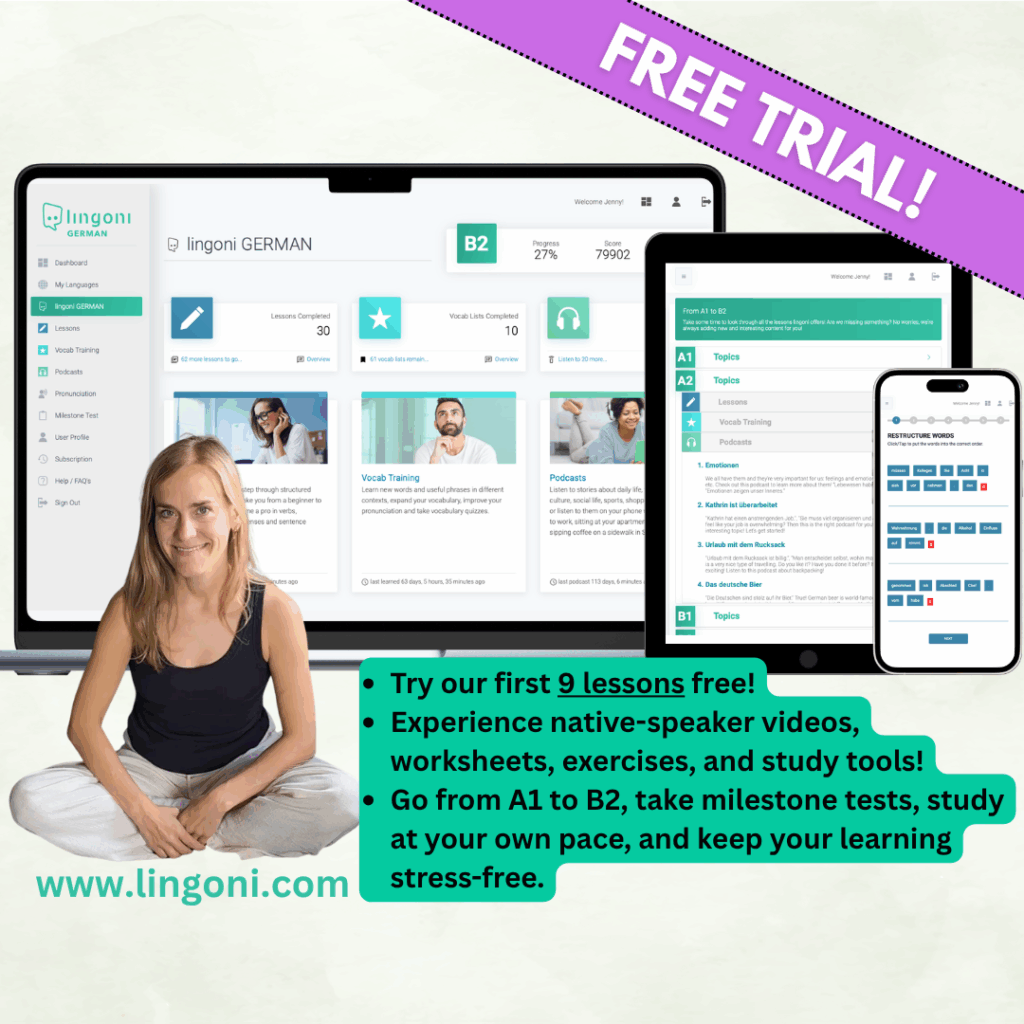
If you want to go beyond a handful of rehearsed phrases and genuinely feel comfortable in German professional settings, you need structured, progressive learning. That is exactly what we built lingoni for.
- Structured lessons from A1 to B2, covering real-life vocabulary and professional German in context
- Interactive exercises including sentence building, listening tasks, and gap-fill activities that train you to recall language under pressure
- Videos, worksheets, and podcasts delivered by qualified native speakers, so you hear how professional German actually sounds
- Milestone Tests at the end of each level that confirm you have genuinely absorbed the material before moving forward
- Live online group courses in small groups of up to 10 students, focused on real-life conversation practice, so you can rehearse exactly the kind of speaking you will do at a networking event
If you are preparing for professional life in a German-speaking country, start building your confidence with our German online course and work your way up to the level where networking in German feels natural, not stressful.