

How Does the Goethe A2 Exam Work and How Do You Prepare?
The Goethe A2 exam is one of the most widely recognized certifications for German learners at the elementary level. Whether the goal is to satisfy a visa requirement, demonstrate language progress to an employer, or simply mark a personal milestone, passing this exam opens real doors. But many candidates underestimate what the test actually involves and walk in underprepared. This guide breaks down everything worth knowing about the Goethe-Institut A2 exam: its structure, scoring, key content areas, and how to study for it effectively.
Goethe A2 Exam Structure and Tested Skills
The Goethe A2 exam tests four core language skills: reading, listening, writing, and speaking. Each skill is assessed in a separate module, and candidates can take all four on the same day or spread them across different dates, a flexibility that suits learners with busy schedules.
- Reading (Lesen): Involves understanding short everyday texts such as advertisements, signs, and messages. Tasks include matching information, identifying true/false statements, and selecting the correct answer from multiple options.
- Listening (Hören): Tests comprehension of short audio recordings, conversations, announcements, and phone messages. Candidates answer multiple-choice or matching questions based on what they hear.
- Writing (Schreiben): Requires producing a short written response, typically a semi-formal message or note based on a prompt, demonstrating basic communicative writing ability.
- Speaking (Sprechen): Conducted in pairs or small groups, this module involves introducing oneself, asking and answering questions, and completing a short collaborative task.
The total exam duration is roughly 75 minutes for the written modules, with the speaking component assessed separately. The format is consistent across all official Goethe-Institut testing centers worldwide.
Scoring, Passing Thresholds, and Certificate Validity

Each of the four modules is worth 25 points, making the total possible score 100 points. To pass the Goethe A2 certificate, candidates must achieve at least 60 points overall and score a minimum of 60% in each individual module. Failing a single module below that threshold means the overall result is a fail, even if the total score exceeds 60.
The certificate itself does not expire. Once earned, the Goethe A2 qualification remains valid indefinitely, which makes it a reliable credential for long-term use, whether for immigration paperwork, academic applications, or professional documentation. Results are typically available within a few weeks of the exam date, depending on the testing center.
Key Topics and Vocabulary to Focus On
The A2 level centers on everyday communication in familiar situations. Knowing which topic areas appear most frequently allows candidates to prioritize their preparation rather than trying to cover everything at once.
Core Thematic Areas
- Personal information: Name, age, nationality, occupation, family, and daily routines
- Housing and environment: Describing a home, neighborhood, and local services
- Shopping and services: Prices, quantities, making requests, and simple transactions
- Health and body: Basic medical vocabulary, symptoms, and appointments
- Travel and transport: Directions, timetables, and booking simple travel arrangements
- Work and leisure: Talking about jobs, hobbies, and free-time activities
Grammar Essentials
At A2, the grammar expectations are specific. Candidates should be confident with the present tense, the simple past (Präteritum) of common irregular verbs, the perfect tense (Perfekt), basic modal verbs, and the accusative and dative cases. Prepositions that govern these cases, such as mit, nach, bei, and für, appear frequently across all four modules.
Effective Study Strategies for the Goethe A2
Structured, consistent preparation matters far more than cramming. Candidates who perform well on the German A2 exam tend to follow a few reliable approaches.
Practice with official materials. The Goethe-Institut publishes sample papers and model tests on its website. Working through these under timed conditions gives a realistic sense of what to expect and highlights weak areas early. Familiarity with the format reduces exam-day anxiety significantly.
Focus on active production, not just recognition. Reading comprehension is passive, writing and speaking are not. Many learners spend most of their study time reading and listening, then struggle when they need to produce language independently. Practicing short written responses and speaking aloud regularly, even without a partner, builds the fluency needed for the productive modules.
Build vocabulary in context. Isolated word lists are less effective than learning vocabulary within sentences or short texts. Grouping new words by topic, housing, health, transport, mirrors the thematic structure of the exam itself and makes retrieval easier under pressure.
Listen to authentic German daily. Even short audio clips, a five-minute podcast, a brief radio segment, a YouTube video aimed at A2 learners, train the ear to process natural speech rhythm and pronunciation. This pays off directly in the listening module. If you want a structured approach to German, organized audio content at the right level makes a measurable difference.
Common Mistakes That Cause Candidates to Lose Points
Even well-prepared candidates can lose marks through avoidable errors. Knowing what these are in advance is one of the most efficient forms of Goethe A2 preparation.
- Ignoring the writing prompt instructions: The writing task specifies what to include, candidates who miss one of the required points lose marks, regardless of how well they write the rest.
- Speaking too little in the oral module: Examiners assess communicative ability. Short, one-word answers do not demonstrate enough language use. Expanding responses with simple connectors like weil, aber, or und dann shows range.
- Skipping the listening questions before the audio plays: In the listening module, reading the questions beforehand allows candidates to listen selectively and catch the specific information needed.
- Neglecting case endings in writing: Errors in accusative and dative endings are among the most common grammar mistakes at A2. These are not ignored by examiners, accuracy in grammar is part of the scoring criteria.
- Underestimating the reading module: Short texts can contain tricky vocabulary or nuanced meaning. Reading too quickly and assuming the answer leads to careless errors.
How lingoni Supports Your Goethe A2 Preparation
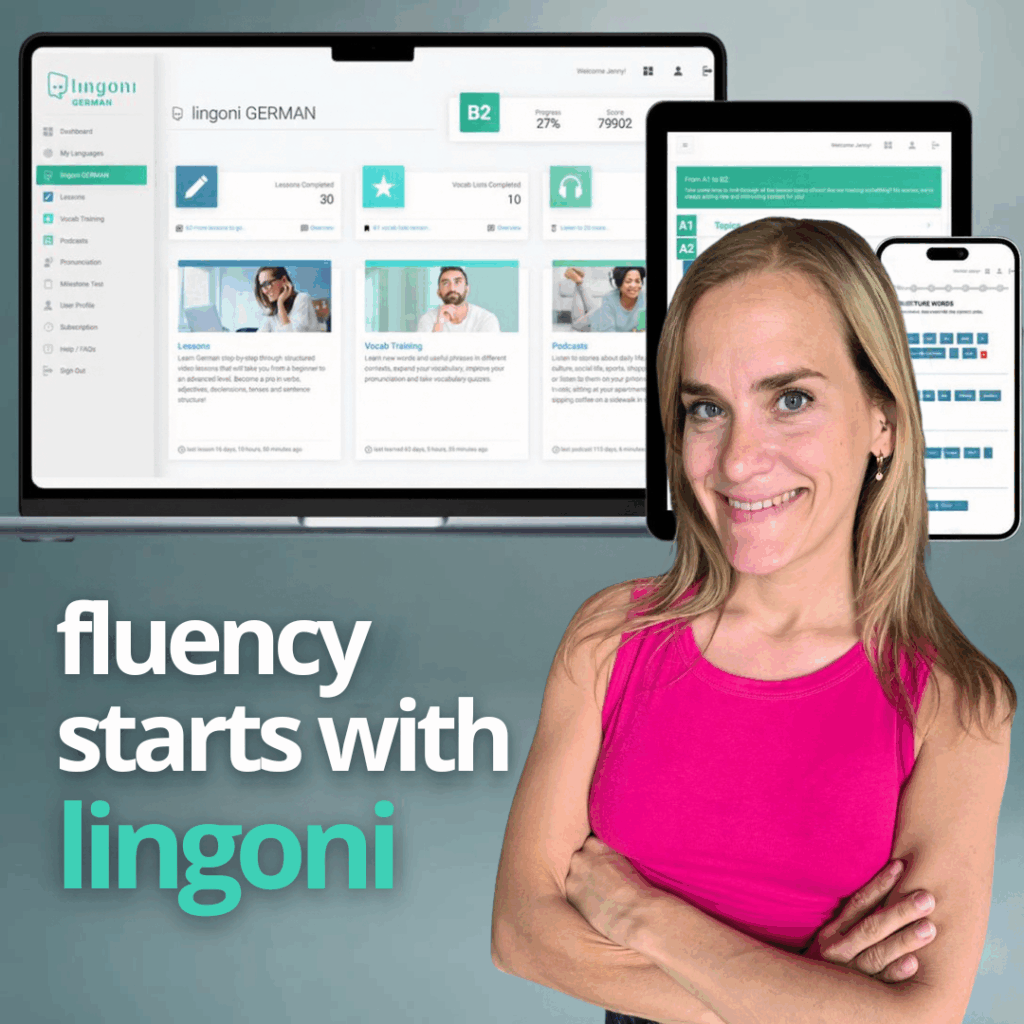
Preparing for the Goethe A2 exam requires consistent practice across all four skills, and that is exactly what we built lingoni around. Our German learning path covers levels A1 through B2: learners select their level, such as A1 or A2, and work through the relevant content in the intended order, with video lessons, podcasts, worksheets, and quizzes that train reading, writing, listening, and speaking in a coordinated way.
Here is what learners working toward A2 get with lingoni:
- Structured progression from A1 to B2, with each level building directly on the previous one, no gaps, no guesswork
- Interactive exercises including fill-in-the-blank, sentence building, picture descriptions, and listening tasks, the same skill types tested in the Goethe exam
- Completely revised worksheets that now also include exercises based on common exam formats such as telc and Goethe
- Milestone tests at the end of each level that serve as a self-check and unlock the next stage of the course
- Podcasts and vocabulary training organized by topic, so learners can focus on the thematic areas most relevant to the A2 exam
- Self-paced learning that fits around work, study, or relocation plans, no fixed schedule required
If you are serious about passing the A2 German language exam and want a structured course that takes you there step by step, start learning German with lingoni and see how far consistent, well-organized practice takes you. A 7-day free trial is available, and you can choose a monthly subscription, which can be cancelled at any time, or an annual or Lifetime option.