

How do you talk to German colleagues without sounding awkward?
Starting a new job in Germany is exciting, but the moment your colleagues switch from polite small talk to rapid-fire German in a team meeting, that excitement can quickly turn into panic. You understand more than you did six months ago, yet something still feels off. The conversations are faster, the vocabulary is more specific, and the unwritten social rules are completely different from what you learned in class. The good news is that communicating naturally with German colleagues is a skill you can build deliberately, and it starts with understanding exactly what makes workplace German different.
Why does talking to German colleagues feel so awkward at first?
Talking to German colleagues feels awkward at first because workplace German combines formal language conventions, industry-specific vocabulary, and a direct communication culture that most language courses do not prepare you for. Even learners at B1 or B2 level often find that classroom German and office German feel like two different languages.
There are a few specific reasons this happens:
- German directness is not rudeness. German professional culture values efficiency and clarity. A colleague who says “Das funktioniert so nicht” (That does not work like this) is not being rude. They are being precise. Once you understand this, the tone of conversations stops feeling cold.
- Workplace vocabulary is specialized. Words like Rücksprache halten (to consult someone), Abstimmungsbedarf (need for coordination), or zeitnah (promptly, in the near future) appear constantly in German offices but rarely in beginner courses.
- You are monitoring yourself too much. When you are unsure of the grammar rules, you spend mental energy checking your sentences instead of listening and responding naturally. This creates a delay that makes conversations feel stilted.
Recognizing these factors is the first step. The awkwardness is not a sign that your German is bad. It is a sign that you need more exposure to the specific register of professional German communication.
What are the most important phrases for the German workplace?

The most important phrases for the German workplace cover four core situations: joining conversations, asking for clarification, contributing in meetings, and wrapping up professional exchanges. Mastering around twenty to thirty set phrases in these categories will cover the majority of your daily office communication.
Here are practical phrases organized by situation:
Starting and joining conversations
- Haben Sie kurz einen Moment? / Hast du kurz einen Moment? — Do you have a quick moment?
- Ich wollte kurz nachfragen, ob… — I wanted to quickly ask whether…
- Darf ich kurz stören? — May I briefly interrupt?
Asking for clarification
- Könnten Sie das bitte wiederholen? — Could you please repeat that?
- Was meinen Sie genau mit…? — What exactly do you mean by…?
- Ich habe das noch nicht ganz verstanden. — I have not fully understood that yet.
Contributing in meetings
- Ich würde gerne etwas dazu sagen. — I would like to add something.
- Meiner Meinung nach… — In my opinion…
- Ich stimme zu, aber… — I agree, but…
Wrapping up
- Ich melde mich dann bei Ihnen. — I will get back to you.
- Wir halten das so fest. — We will note it that way / We agree on that.
- Vielen Dank für das Gespräch. — Thank you very much for the conversation.
Write these phrases down and practice them out loud before you need them. Passive knowledge of a phrase is very different from being able to produce it under pressure in a real conversation.
When should you use ‘du’ vs. ‘Sie’ with colleagues?
You should use Sie (formal you) with colleagues until someone explicitly invites you to use du, or until the team culture makes it clear that du is the default. In Germany, using du before it is offered can come across as presumptuous, while using Sie is always safe and respectful.
The practical rules are straightforward:
- Use Sie with your manager, with colleagues you have just met, with people in other departments, and in any formal written communication like emails.
- Use du once a colleague says something like “Wir können uns ruhig duzen” (We can use du with each other) or “Du kannst mich einfach duzen.”
- Watch the team culture. Many startups and international companies in Germany have already adopted du across the board. If everyone around you uses du freely, it is fine to follow suit.
- In writing, follow the lead of the person you are replying to. If they write to you using du, respond in kind.
When in doubt, default to Sie. No German colleague will be offended by being addressed formally. The reverse is not always true.
How can you follow fast German conversations in team meetings?
You can follow fast German conversations in team meetings by preparing topic-specific vocabulary in advance, focusing on key words rather than every sentence, and using short clarifying questions to stay engaged rather than falling silent when you lose the thread.
Here is a practical approach for getting more out of meetings:
- Prepare before the meeting. If you know the agenda topics, look up the relevant German vocabulary beforehand. Knowing the ten or fifteen words most likely to come up dramatically improves comprehension.
- Focus on nouns and verbs. When speech is fast, your brain cannot process every word. Train yourself to catch the main nouns and verbs first. They carry most of the meaning.
- Ask for repetition without apology. “Könnten Sie das bitte noch einmal sagen?” is a completely normal and professional request. Most colleagues will not mind at all.
- Take notes in German. Writing down words as you hear them, even if you are not sure of the spelling, reinforces listening comprehension over time.
- Review after the meeting. Look up words you could not catch. Over time, the same vocabulary will keep appearing, and your comprehension will improve noticeably.
Listening comprehension in a professional setting takes longer to develop than speaking skills. Be patient with yourself and treat every meeting as a training session.
What mistakes should you avoid when speaking German at work?
The most common mistakes to avoid when speaking German at work include over-apologizing for your language level, mixing registers (using casual speech in formal situations), translating idioms directly from your native language, and staying silent instead of asking for clarification.
Here are the specific mistakes that tend to hold people back:
- Over-apologizing. Starting every sentence with “Sorry, my German is not very good” draws attention to your insecurity and can undermine how colleagues perceive your confidence. A short “Ich lerne noch” (I am still learning) once is enough. After that, just speak.
- Translating idioms directly. Phrases that work in English or another language often produce confusing or funny results in German. When in doubt, use simple, direct language rather than idiomatic expressions you are not sure about.
- Using informal language in formal emails. German business writing tends to be more formal than its English equivalent. Starting an email with “Hey” when “Sehr geehrte Frau Müller” is expected can create a poor impression.
- Staying silent when confused. Nodding along when you have not understood something is a short-term strategy that creates long-term problems. Ask for clarification in the moment. It is always the more professional choice.
- Avoiding speaking altogether. Some learners switch to English at the first sign of difficulty. This is understandable, but it slows your progress significantly. Push yourself to stay in German even when it is uncomfortable.
How do you get comfortable speaking German with colleagues faster?
You get comfortable speaking German with colleagues faster by creating regular, low-stakes speaking opportunities outside of high-pressure meetings, building a working vocabulary specific to your industry, and treating every real conversation as practice rather than a test.
Practical strategies that actually work:
- Start with one-on-one conversations. Talking to a single colleague over coffee is far less intimidating than speaking in a full team meeting. Use these smaller interactions to build confidence with the language first.
- Learn your industry vocabulary actively. Make a list of the twenty most common terms in your field and practice using them in sentences. Domain-specific fluency makes you sound far more competent, even if your grammar is still developing.
- Ask colleagues to correct you. Most people appreciate being asked. A simple “Kannst du mich korrigieren, wenn ich einen Fehler mache?” (Can you correct me when I make a mistake?) turns a colleague into a language partner.
- Set a speaking goal for each week. For example, commit to initiating at least two German conversations per day, or to asking one question in German during every team meeting. Small, consistent goals produce real results.
- Listen to German content related to your field. Podcasts, news programs, and YouTube channels focused on your industry expose you to the vocabulary and speech patterns you will actually use at work.
Progress in workplace German is not linear, but it is cumulative. Every conversation you have, even an imperfect one, builds the neural pathways that make the next conversation easier.
How lingoni helps you learn German for the workplace
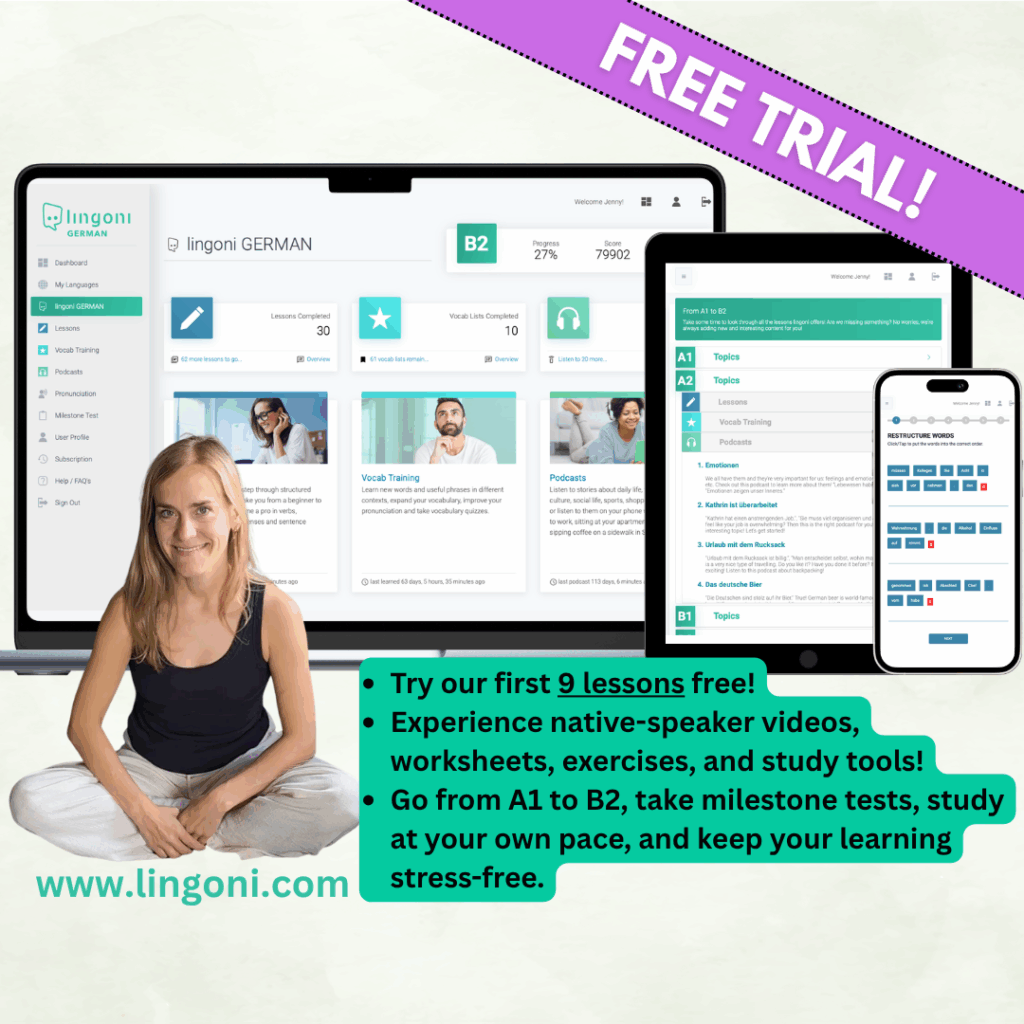
If you want to build the kind of German that actually holds up in professional settings, structured, level-appropriate practice makes the difference. At lingoni, we designed our German course specifically for adult learners who need real progress, not just vocabulary lists.
Here is what you get with the lingoni German online course:
- Structured learning from A1 to B2, with video lessons, podcasts, worksheets, and interactive exercises covering reading, writing, listening, and speaking skills
- Milestone Tests at the end of each level so you can confirm your progress before moving on, or skip ahead if you are already at an intermediate level
- Flexible, self-directed study that fits around your work schedule, whether you have thirty minutes a day or a full hour
- Preparation for official exams including Goethe, telc, DSH, and TestDaF, if your employer or visa situation requires a formal qualification
- Live online conversation courses in small groups, so you get real speaking practice in a low-pressure environment before you need it in the office
If you are serious about communicating confidently with your German colleagues, consistent structured practice is the most direct route there.
Related Articles
- How Do You Write a Formal Email in a German Language Exam?
- What German should you learn before your first day at a new job?
- What German soft skills do employers actually look for in international candidates?
- What German Level Do You Need to Live and Work in Germany?
- Does Watching German TV Actually Help You Learn?