

How do you talk about your job title and responsibilities in German?
If you live or work in a German-speaking country, one of the first things people will ask you is: “Was machst du beruflich?” — What do you do for work? Knowing how to answer that question confidently, and how to talk about your daily tasks and workplace, is one of the most practical things you can do with your German. This guide walks you through the vocabulary and phrases you actually need, from stating your job title in German to handling a full job interview.
How do you say your job title in German?
To say your job title in German, you use the verb sein (to be) without an article: “Ich bin Ingenieur” (I am an engineer). Unlike English, German drops the indefinite article “a” when stating professions. This applies to both written and spoken German and is one of the first grammar rules worth getting right.
German job titles also change depending on gender. Most professions have a masculine and a feminine form, with the feminine version typically adding -in to the end:
- der Lehrer (male teacher) / die Lehrerin (female teacher)
- der Arzt (male doctor) / die Ärztin (female doctor)
- der Ingenieur / die Ingenieurin
- der Buchhalter (male accountant) / die Buchhalterin (female accountant)
In more formal or written contexts, you may also see the combined form Lehrer/in or the gender-neutral spelling Lehrende. When in doubt, use the form that matches your gender, and you will sound natural right away.
How do you introduce your profession in a German conversation?
The most natural way to introduce your profession in a German conversation is with the phrase “Ich bin [Berufsbezeichnung]” or “Ich arbeite als [Berufsbezeichnung]” — I work as a [job title]. Both are widely used, and combining them with a sentence about your employer or field makes your introduction sound complete and confident.
Here are some ready-to-use phrases for introducing yourself professionally in German:
- Ich bin Softwareentwickler. — I am a software developer.
- Ich arbeite als Krankenpfleger. — I work as a nurse.
- Ich bin in der IT-Branche tätig. — I work in the IT sector.
- Ich bin selbstständig. — I am self-employed.
- Ich bin momentan auf Jobsuche. — I am currently looking for a job.
If you want to add more context, you can follow up with: “Ich arbeite bei [Firmenname]” (I work at [company name]) or “Ich bin seit drei Jahren in diesem Beruf” (I have been in this profession for three years). These small additions make you sound much more fluent in everyday conversation.
In the following video, Jenny teaches you how to talk about what you do for a living in German.
What German phrases describe daily work tasks and responsibilities?
To describe your daily work tasks and responsibilities in German, use verbs like zuständig sein für (to be responsible for), sich kümmern um (to take care of), and leiten (to manage or lead). These are the building blocks of any professional description in German.
Here is a set of practical phrases you can adapt to your own role:
- Ich bin zuständig für die Kundenbetreuung. — I am responsible for customer service.
- Ich kümmere mich um die Buchhaltung. — I take care of the accounting.
- Ich leite ein Team von fünf Personen. — I manage a team of five people.
- Ich erstelle Berichte und Präsentationen. — I create reports and presentations.
- Ich arbeite eng mit anderen Abteilungen zusammen. — I work closely with other departments.
- Ich nehme regelmäßig an Meetings teil. — I regularly attend meetings.
Notice that German often uses separable verbs in these phrases, like zusammenarbeiten (to collaborate) or teilnehmen (to participate). Getting comfortable with these verbs will make your descriptions of responsibilities sound much more natural when you speak about your Beruf auf Deutsch.
How do you talk about your workplace and employer in German?
To talk about your workplace and employer in German, use “Ich arbeite bei” followed by the company name, or “Ich arbeite in” followed by the type of workplace. The preposition changes depending on context: bei is used for named employers, while in is used for types of places like hospitals, schools, or offices.
Useful phrases for describing your workplace include:
- Ich arbeite bei Siemens. — I work at Siemens.
- Ich arbeite in einem kleinen Unternehmen. — I work in a small company.
- Ich arbeite in einem Krankenhaus. — I work in a hospital.
- Mein Büro ist im Stadtzentrum. — My office is in the city center.
- Ich arbeite von zu Hause aus. — I work from home.
- Ich bin im Homeoffice. — I work remotely / I am in the home office.
The word Homeoffice is now completely standard in German professional life and will come up in almost any workplace conversation. You can also describe the size or type of company: ein Konzern (a large corporation), ein mittelständisches Unternehmen (a medium-sized company), or ein Start-up (a startup).
What German vocabulary do you need for a job interview?
For a job interview in German, you need vocabulary around your qualifications, experience, strengths, and motivation. Key phrases include “Ich habe Erfahrung in…” (I have experience in…), “Meine Stärken sind…” (My strengths are…), and “Ich bewerbe mich, weil…” (I am applying because…). These cover the core questions interviewers ask most often.
Here is a focused list of German job interview vocabulary worth learning before your next conversation:
- die Bewerbung — the application
- der Lebenslauf — the CV / résumé
- die Gehaltsvorstellung — salary expectation
- die Probezeit — probationary period
- die Stelle / die Position — the position / the role
- die Qualifikation — qualification
- die Berufserfahrung — professional experience
- teamfähig — able to work in a team
- belastbar — resilient / able to work under pressure
- motiviert — motivated
A common interview question is “Warum möchten Sie bei uns arbeiten?” (Why do you want to work with us?). Preparing a short, honest answer using phrases like “Ich schätze das Arbeitsumfeld” (I value the work environment) or “Diese Position passt gut zu meinen Fähigkeiten” (This position fits my skills well) will make a strong impression.
If you want structured practice with this kind of German work vocabulary, building it step by step from beginner to advanced level makes a real difference when the actual interview comes.
What are the most common mistakes when describing jobs in German?
The most common mistakes when describing jobs in German are using the wrong article with professions, confusing the prepositions bei and in for workplaces, and forgetting to use the gender-appropriate form of a job title. These errors are easy to make but also easy to correct once you know what to watch for.
Using an article before a profession
In English, you say “I am a teacher.” In German, you say “Ich bin Lehrer” — no article. Adding ein or eine is one of the most frequent mistakes among English speakers learning German for work. The article only appears when you add an adjective: “Ich bin ein guter Lehrer” (I am a good teacher).
Forgetting gender agreement on job titles
Using the masculine form of a job title when you identify as female is a common slip. In professional settings, especially in Germany and Austria, using the correct gendered form is noticed. If you are a female project manager, say Projektleiterin, not Projektleiter.
Mixing up prepositions for workplace
Use bei for named companies (Ich arbeite bei BMW) and in for types of institutions (Ich arbeite in einer Schule). Swapping these makes sentences sound unnatural to a native speaker, even if the meaning is clear.
Overusing formal vocabulary in casual conversation
Phrases like “Ich bin im Bereich der Informationstechnologie tätig” are perfectly correct but sound stiff in a casual chat. In everyday conversation, keep it simple: “Ich arbeite in der IT” works just as well and sounds much more natural.
How lingoni helps you build German work vocabulary
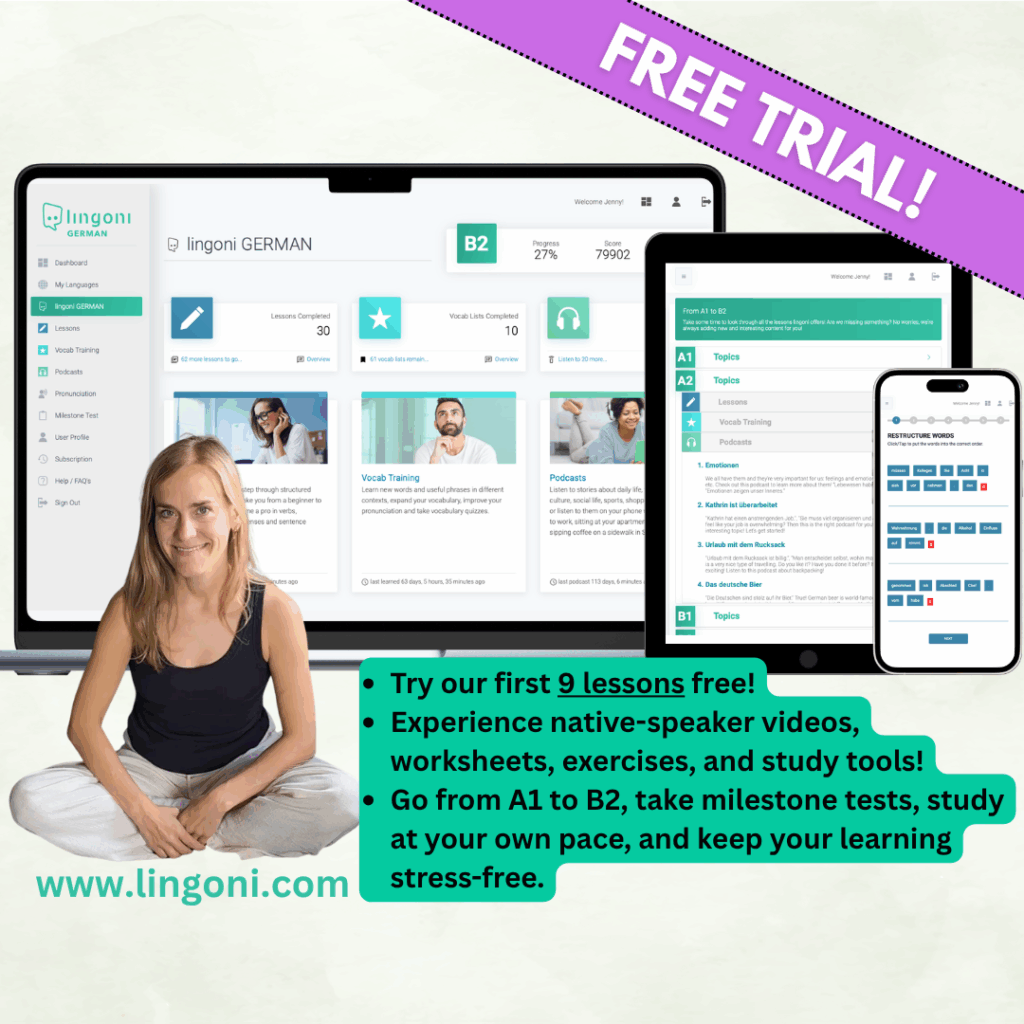
Learning job-related German is not just about memorizing words. You need to hear how native speakers actually use them, practice building sentences yourself, and get feedback when you go wrong. That is exactly what we built lingoni to do.
With lingoni GERMAN, you get:
- Structured lessons from A1 to B2, covering professional vocabulary in real-life contexts
- Videos, podcasts, and worksheets taught by qualified native speakers
- Interactive exercises where you fill in blanks, build sentences, and correct mistakes — not just passive watching
- Milestone Tests at the end of each level so you can confirm your progress before moving on
- The flexibility to learn at your own pace, whether you have 15 minutes a day or a full hour
If you are preparing for work life in a German-speaking country, building your vocabulary around real professional situations is the most direct path forward. Start your free trial with lingoni GERMAN and see how quickly structured practice adds up.