
How Do You Overcome Speaking Anxiety in a German Oral Exam?
The moment the examiner says “Let’s begin,” something shifts. The mouth goes dry, the mind empties, and suddenly even basic German words feel unreachable. Speaking anxiety in a German oral exam is one of the most common challenges learners face, and it has nothing to do with how much they’ve studied. Whether it’s the Goethe oral exam, a telc speaking exam, or a university language assessment, the pressure of performing in real time triggers a stress response that can undermine even well-prepared candidates. The good news is that this kind of anxiety is manageable, and the right strategies make a real difference.
Why Speaking Anxiety Hits Harder in German Oral Exams
Speaking anxiety in a German oral exam feels uniquely intense because the format removes the safety net that written exams offer. There is no time to draft, revise, or look something up. Every word is heard immediately, judged in real time, and cannot be taken back. For learners who have spent most of their study time with textbooks and exercises, this live exposure can feel like a completely different skill.
German adds another layer of difficulty. The language’s grammatical structure, with its case system, verb placement rules, and gendered nouns, requires a level of active processing that becomes harder under stress. When anxiety spikes, the brain’s working memory narrows, and that’s precisely where grammar and vocabulary retrieval live. This is why a learner might blank on a word they’ve used dozens of times in writing but can’t access in the moment. Understanding this mechanism helps: it’s not a sign of failure, it’s a predictable physiological response.
Breathing and Grounding Techniques That Calm Exam Nerves Fast

Controlled breathing is one of the fastest ways to interrupt the anxiety response before or during a German speaking test. The technique works because slow, deliberate exhales activate the parasympathetic nervous system, signaling to the body that the threat has passed. A simple method: inhale for four counts, hold for four, exhale for six. Even two or three cycles before entering the exam room can noticeably lower heart rate and clear mental fog.
Grounding techniques work differently but complement breathing well. Before the exam, try pressing both feet flat on the floor and noticing the physical sensation. This redirects attention away from anxious thoughts and back to the present moment. Inside the exam, if nerves spike, a slow, deliberate breath before answering buys a few seconds of recovery time and is completely natural to an examiner: it signals that the candidate is thinking, not panicking.
How to Prepare Your Speaking So Anxiety Has Less Room to Grow
The most effective long-term strategy against language anxiety is building genuine familiarity with spoken German before exam day. Anxiety often fills the space that preparation leaves empty. The more automatic certain phrases and structures feel, the less cognitive load they require under pressure, which means more mental bandwidth for actual communication.
Practice with real-time feedback
Reading and listening alone won’t build speaking confidence. Regular speaking practice, ideally with a conversation partner or a tutor, trains the brain to retrieve language under time pressure. Simulating exam conditions matters too: practice answering questions out loud without pausing to look anything up, even if the first attempts feel rough.
Build a personal phrase toolkit
Prepare a small set of flexible phrases for common exam moments: expressing uncertainty (“Ich bin nicht sicher, aber ich denke…”), buying time (“Das ist eine interessante Frage…”), and clarifying (“Meinen Sie…?”). These phrases don’t need to be impressive, they need to be automatic. When the mind goes blank, a reliable phrase can restart the flow and give the brain a moment to catch up.
Consistent German speaking practice in the weeks before an exam matters far more than cramming vocabulary lists the night before. Familiarity breeds confidence, and confidence shrinks anxiety.
In-the-Moment Strategies for When Your Mind Goes Blank
Blanking mid-sentence is one of the most feared moments in a German oral exam, and one of the most common. The key is having a plan for it before it happens, so the reaction becomes automatic rather than panicked.
When a word disappears, try describing it instead. If “Verkehrsstau” doesn’t come, say “viele Autos auf der Straße, die nicht fahren können.” Examiners are not looking for a perfect vocabulary list, they’re assessing communication ability. Circumlocution (talking around a missing word) is a legitimate and impressive skill. Similarly, if a grammatical structure feels too risky, simplify. A clear, short sentence in the right tense beats a complex sentence with three errors.
Silence feels longer to the speaker than to the examiner. A two-second pause before answering is normal and even signals thoughtfulness. If more time is needed, use a filler phrase, “Moment, ich überlege kurz,” rather than rushing into a confused answer. Recovering calmly from a blank moment often impresses examiners more than never faltering at all.
Common Mistakes Anxious Speakers Make in German Oral Exams
Anxiety doesn’t just cause silence, it causes specific, predictable errors that can cost marks even when the underlying knowledge is solid. Recognizing these patterns in advance helps avoid them.
- Over-apologizing: Saying “Sorry, my German is not very good” undermines confidence and wastes exam time. Examiners already know the level, the goal is to show what can be communicated, not what can’t.
- Speaking too fast: Nerves often accelerate speech, which increases errors and reduces clarity. A slower, deliberate pace sounds more confident and gives the brain time to form correct structures.
- Abandoning a sentence mid-way: Starting a sentence and stopping because the ending feels uncertain is more disruptive than finishing with a small error. Commit to the sentence and adjust afterward.
- Ignoring the examiner’s cues: Anxiety can cause tunnel vision. Examiners often give subtle prompts or show understanding with nods, staying present and responsive to those signals can actually reduce the pressure.
- Translating from the first language: Trying to construct German sentences by mentally translating from English slows everything down and often produces unnatural phrasing. Practicing thinking directly in German, even imperfectly, builds a more fluent response pattern over time.
How lingoni Helps You Build Confidence for German Speaking Exams
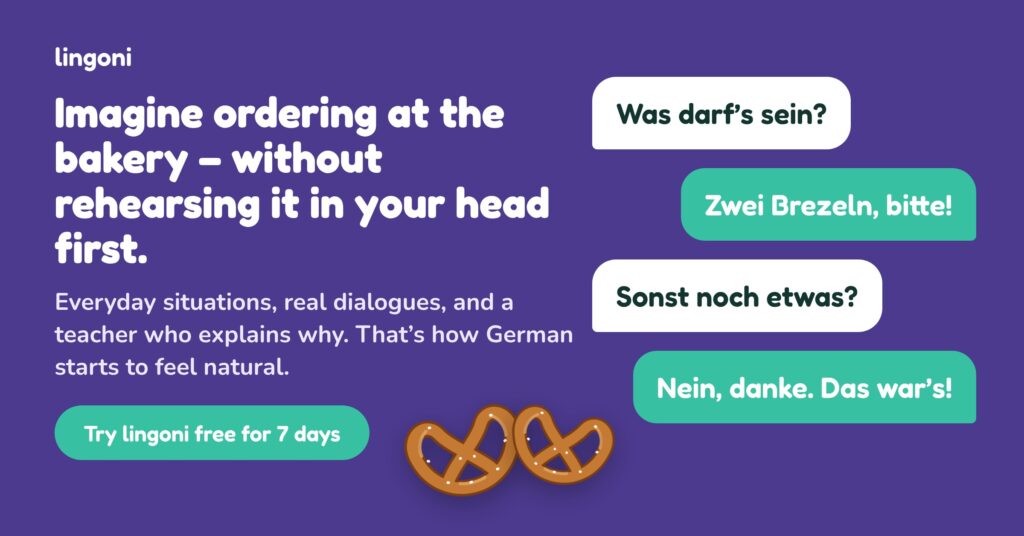
Reducing speaking anxiety starts long before exam day, it’s built through consistent, structured practice that makes German feel familiar rather than foreign. That’s exactly what we designed lingoni to support.
- Structured progression from A1 to B2: Learners select their level, for example A1, and follow one structured learning path with all the relevant content in the intended order, so speaking skills develop in a logical sequence rather than through guesswork.
- Video lessons, podcasts, worksheets and quizzes: The learning path combines all four formats. The worksheets have been completely revised and now include exercises based on common exam formats such as telc and Goethe.
- Milestone Tests at the end of each level: These serve as both a self-check and a gateway to the next level, giving learners a clear sense of where they stand before exam day.
- Interactive speaking and listening exercises: Exercises include picture descriptions, sentence building, and listening tasks that mirror the format of real exams like Goethe and telc.
- Flexible subscription options: Choose a monthly subscription that can be cancelled at any time, or opt for the annual or Lifetime option. A 7-day free trial is available.
If a German oral exam is on the horizon and speaking confidence feels shaky, structured practice is the most reliable path forward. Explore German courses on lingoni and start building the speaking skills that hold up when it matters most.