
How do you introduce yourself professionally in German?
Knowing how to introduce yourself professionally in German is one of the most practical skills you can develop as an expat, immigrant, or professional working in a German-speaking country. Whether you are walking into a job interview in Berlin, joining a new team in Vienna, or meeting clients in Zurich, the way you present yourself in those first few minutes sets the tone for everything that follows. The good news is that German professional introductions follow a clear structure, and once you know the key phrases and conventions, you can prepare with confidence.
What does a professional self-introduction in German look like?
A professional self-introduction in German typically follows a structured sequence: your name, where you are from, your professional background, your current role or reason for being there, and a brief statement about your goals or motivation. It is concise, direct, and avoids overly personal details unless specifically invited.
In German professional culture, directness is valued. People appreciate a clear, well-organized introduction rather than a rambling or overly casual one. A typical self-introduction at a business meeting or interview might run between 60 and 90 seconds and cover these core elements:
- Name: “Mein Name ist…” or “Ich heiße…”
- Origin or current location: “Ich komme aus…” or “Ich wohne zurzeit in…”
- Professional background: “Ich arbeite seit X Jahren als…” or “Ich habe einen Abschluss in…”
- Current situation or purpose: “Ich bin hier, weil…” or “Ich bewerbe mich für die Stelle als…”
- Motivation or goal: “Ich möchte…” or “Mein Ziel ist es, …”
Think of it as a professional snapshot rather than a full biography. You are giving the other person enough context to understand who you are and why you are relevant to the situation.
What are the key phrases for introducing yourself in German?
The most useful German phrases for a professional self-introduction include greetings, name statements, origin phrases, job title expressions, and closing remarks. Mastering these phrases gives you a solid foundation for any formal or semi-formal situation in a German-speaking workplace.
Here are the phrases you will use most often when introducing yourself in German professionally:
- Guten Morgen / Guten Tag / Guten Abend — Good morning / Good day / Good evening
- Mein Name ist [Name]. — My name is [Name].
- Ich heiße [Name]. — My name is [Name]. (slightly more informal)
- Ich komme aus [Land/Stadt]. — I come from [country/city].
- Ich bin [Berufsbezeichnung]. — I am a [job title].
- Ich arbeite bei [Unternehmen]. — I work at [company].
- Ich habe X Jahre Erfahrung in… — I have X years of experience in…
- Ich freue mich, Sie kennenzulernen. — I am pleased to meet you.
- Es ist mir eine Freude, hier zu sein. — It is a pleasure to be here.
Pronunciation matters more than people expect in German. Words like “Berufserfahrung” (professional experience) and “Betriebswirtschaft” (business administration) can trip up learners at first, so practice saying your introduction out loud before the real moment arrives. Recording yourself and listening back is one of the most effective ways to catch mistakes before they happen in a real conversation.
How do you introduce yourself in a German job interview?

In a German job interview, you introduce yourself by starting with a polite greeting, stating your name and background, summarizing your professional experience and qualifications, and explaining why you are interested in the role. Keep it focused and relevant, and avoid unnecessary personal details unless asked.
A common opening question in German job interviews is “Erzählen Sie uns etwas über sich” (Tell us something about yourself) or “Stellen Sie sich bitte kurz vor” (Please introduce yourself briefly). Here is an example structure you can adapt:
“Guten Tag, mein Name ist Maria Hoffmann. Ich komme ursprünglich aus Spanien und lebe seit drei Jahren in Deutschland. Ich habe einen Bachelor-Abschluss in Betriebswirtschaft und arbeite seit fünf Jahren im Bereich Marketing. Zuletzt war ich bei einem mittelständischen Unternehmen in München tätig, wo ich für die digitale Kommunikation verantwortlich war. Ich bewerbe mich für diese Stelle, weil ich meine Erfahrungen weiterentwickeln und in einem internationalen Umfeld arbeiten möchte.”
Translation: “Good day, my name is Maria Hoffmann. I originally come from Spain and have been living in Germany for three years. I have a bachelor’s degree in business administration and have worked in marketing for five years. Most recently, I worked at a medium-sized company in Munich, where I was responsible for digital communications. I am applying for this position because I want to develop my skills further and work in an international environment.”
Notice how the introduction is structured, specific, and forward-looking. German interviewers tend to appreciate candidates who are well-prepared and get to the point quickly.
What’s the difference between formal and informal introductions in German?
The main difference between formal and informal introductions in German is the use of “Sie” (formal you) versus “du” (informal you), along with different vocabulary choices and levels of personal detail. In professional settings, always default to “Sie” unless the other person explicitly invites you to use “du.”
Formal introductions (Sie)
Formal introductions use last names, polite greetings like “Guten Tag” rather than “Hallo,” and more structured language. You would say “Darf ich mich vorstellen? Mein Name ist Müller.” (May I introduce myself? My name is Müller.) rather than jumping straight into a first-name basis.
Informal introductions (du)
Informal introductions are more relaxed, use first names, and often start with “Hallo” or “Hi.” You might say “Hey, ich bin Jonas. Ich arbeite in der IT-Abteilung.” This is appropriate with colleagues of a similar age or in startup environments where the company culture is explicitly casual.
A practical rule of thumb: if you are unsure, stay formal. Switching from formal to informal is easy once invited. Going the other way is awkward and can leave a negative impression in professional contexts.
In the following video. Jenny gives you examples of jow to introduce yourself in a business context.
What mistakes should you avoid when introducing yourself in German?
The most common mistakes when introducing yourself in German include using “du” too early, over-translating from English word order, mispronouncing your own job title, and giving an introduction that is either too long or too vague. Each of these can undermine an otherwise strong first impression.
- Using “du” without being invited: This is one of the most common errors among English speakers, since English has only one form of “you.” In German professional settings, using “du” prematurely can come across as presumptuous.
- Word order errors: German sentence structure places the verb in the second position, which often differs from English. Saying “Ich bin seit fünf Jahren Ingenieur” is correct; rearranging it incorrectly can confuse listeners.
- Mispronouncing job titles or company names: Practice saying your specific role out loud. German compound nouns like “Softwareentwickler” (software developer) or “Projektmanagerin” (female project manager) require some rehearsal.
- Being too vague: Saying only “Ich arbeite im Marketing” without any context leaves the listener with nothing to follow up on. Be specific about your role, industry, or the type of work you do.
- Going on too long: A professional German self-introduction should be concise. If someone asks you to introduce yourself briefly, two to three sentences is often enough. Save the details for when they are asked.
One often overlooked point is the handshake. In German professional culture, a firm handshake while making eye contact is standard when meeting someone for the first time. Combining that physical greeting with a confident verbal introduction makes a noticeably stronger impression.
How lingoni helps you practice professional German introductions
Knowing the phrases is one thing. Being able to use them naturally under pressure is another. That is exactly where structured practice makes the difference.
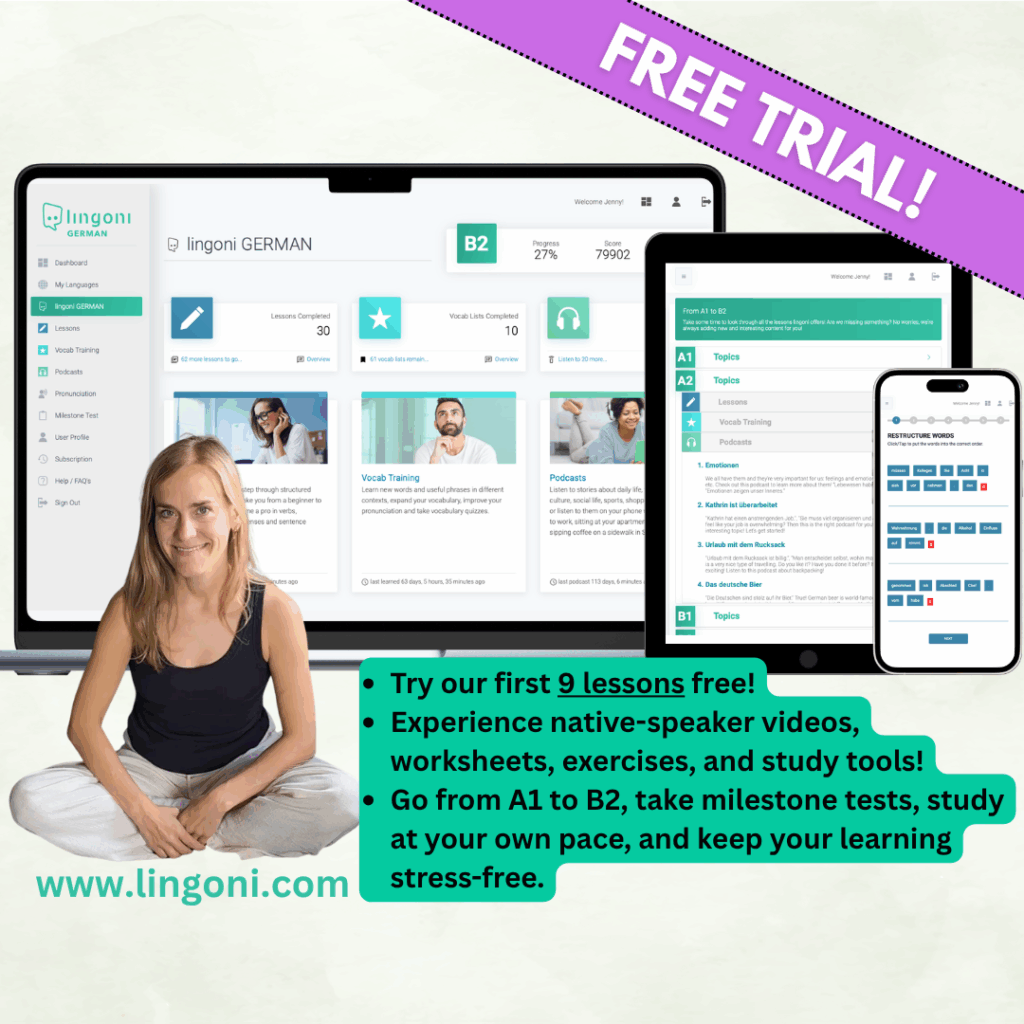
At lingoni, we offer a complete German course that takes you from A1 to B2, with content specifically designed for real-life situations like workplace conversations, introductions, and professional dialogue. Here is what you get access to:
- Video lessons taught by qualified native speakers, covering practical vocabulary and grammar in context
- Interactive exercises including sentence building, fill-in-the-blank tasks, and listening comprehension that train you to use phrases actively, not just recognize them
- Podcasts that expose you to natural spoken German at different speeds and levels
- Milestone Tests at the end of each level so you can confirm your progress before moving on
- Live online conversation courses in small groups, where you can practice speaking in real time with an instructor and other learners
If you are preparing for a job interview, a new role in Germany, or simply want to feel confident the next time someone asks you to introduce yourself, explore our German course and start building the speaking confidence you need.
Related Articles
- How do you understand a German rental contract before signing?
- What German soft skills do employers actually look for in international candidates?
- How do you get health insurance in Germany as a new employee?
- How to Stay Consistent When Learning German Around a Busy Life
- How to Self-Study German Effectively