How do you handle a job interview entirely in German as a non-native speaker?
Walking into a job interview is nerve-wracking enough in your first language. Doing it entirely in German as a non-native speaker? That takes real preparation and a clear strategy. The good news is that German employers who hire internationally are used to working with non-native speakers, and with the right vocabulary, practice, and mindset, you can absolutely hold your own. Here is everything you need to know to handle a German job interview with confidence.
What should you expect from a job interview in German?
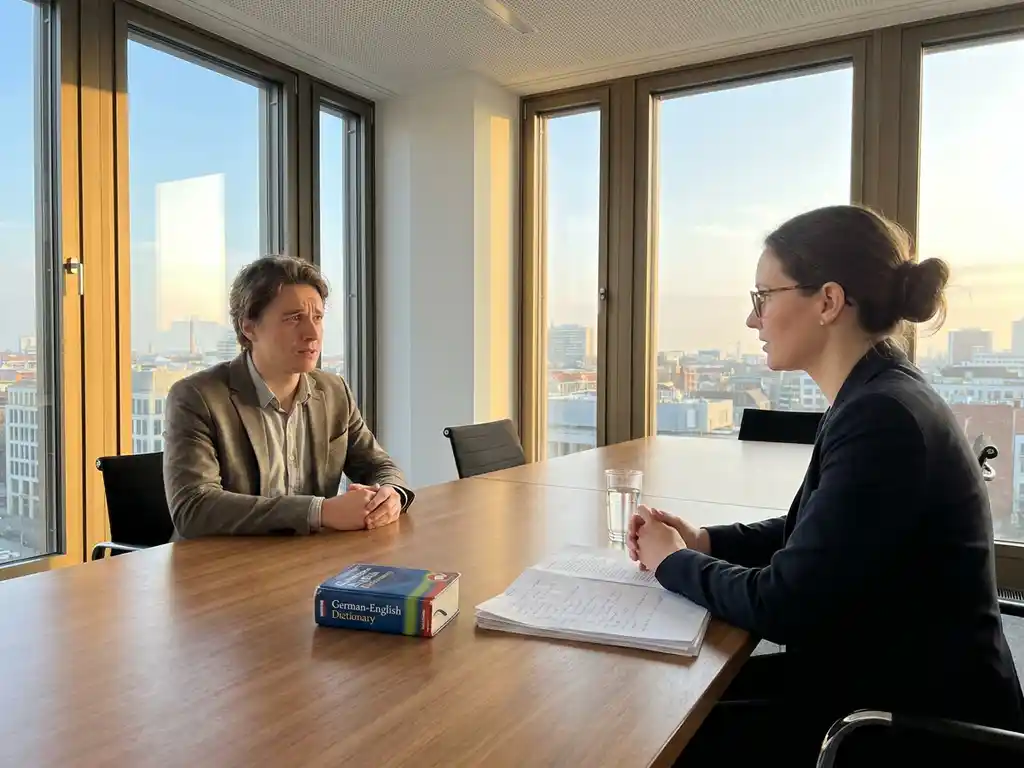
A job interview in German follows a fairly predictable structure: a brief introduction, questions about your background and motivation, role-specific questions, and time for your own questions. Most interviews last between 45 and 90 minutes. In Germany, interviews tend to be formal, structured, and direct. Small talk is minimal, and interviewers get to the point quickly.
You will typically be interviewed by one or two people, often from HR and the relevant department. Expect questions about your CV, your reasons for applying, your strengths and weaknesses, and how you handle specific work situations. German interviewers value precision and honesty, so vague or overly polished answers can actually work against you.
One thing worth knowing: formality matters. Unless the interviewer explicitly switches to du, always use Sie. Getting that wrong early on can create an awkward impression that is hard to shake.
What German phrases do you need for a job interview?
For a German job interview, you need phrases that cover four core areas: introducing yourself, describing your experience, expressing motivation, and asking questions. Having these ready in advance means you spend less mental energy searching for words and more on actually communicating.
Here are some of the most useful phrases to prepare:
- Ich heiße … und ich komme aus … (My name is … and I am from …)
- Ich habe X Jahre Erfahrung in … (I have X years of experience in …)
- Ich bewerbe mich, weil … (I am applying because …)
- Meine größte Stärke ist … (My greatest strength is …)
- Ich arbeite gerne im Team, aber ich kann auch selbstständig arbeiten. (I enjoy working in a team, but I can also work independently.)
- Welche Möglichkeiten zur Weiterbildung bietet das Unternehmen? (What professional development opportunities does the company offer?)
- Wann kann ich mit einer Rückmeldung rechnen? (When can I expect to hear back?)
Beyond specific phrases, practice transitional expressions like zum Beispiel (for example), außerdem (in addition), and meiner Meinung nach (in my opinion). These help you build more natural, flowing answers rather than clipped, fragmented responses.
How do you answer common German interview questions?

The most common German interview questions follow a recognizable pattern. Knowing what to expect lets you prepare structured answers in advance rather than improvising under pressure.
Here are the questions you are most likely to face and how to approach them:
- “Erzählen Sie etwas über sich.” (Tell me about yourself.) Keep this to two to three minutes. Cover your professional background, your most relevant experience, and why you are applying. Avoid going too far back into your personal history.
- “Warum bewerben Sie sich bei uns?” (Why are you applying to us?) Research the company beforehand. Reference something specific, whether it is their industry reputation, a recent project, or their company culture.
- “Was sind Ihre Stärken und Schwächen?” (What are your strengths and weaknesses?) Be honest and specific. For weaknesses, mention something real and follow it with what you are doing to improve.
- “Wo sehen Sie sich in fünf Jahren?” (Where do you see yourself in five years?) Align your answer with growth within the role and the company. Show ambition without sounding like you are planning to leave.
- “Warum haben Sie Ihr letztes Unternehmen verlassen?” (Why did you leave your last company?) Stay professional. Focus on what you were looking for, not what you were trying to get away from.
Prepare short, concrete answers in German for each of these. You do not need to be fluent to answer them well. You need to be clear and honest.
What do you do when you don’t understand a question in German?
If you do not understand a question during a German job interview, ask for clarification immediately and politely. Pretending to understand and then answering the wrong question is far more damaging than admitting you missed something. Interviewers respect candidates who communicate clearly, even about their own limitations.
Use these phrases to buy yourself a moment:
- “Könnten Sie die Frage bitte wiederholen?” (Could you please repeat the question?)
- “Könnten Sie das bitte etwas langsamer sagen?” (Could you say that a little more slowly?)
- “Habe ich das richtig verstanden, dass …?” (Did I understand correctly that …?)
- “Was meinen Sie genau mit …?” (What exactly do you mean by …?)
Using these phrases confidently actually signals good communication skills, which is exactly what employers want to see. Stay calm, take a breath, and ask. It is never the wrong move.
How can you prepare your German for a job interview?
Preparing your German for a job interview means focusing on the specific vocabulary, sentence structures, and speaking situations you will actually encounter, not just general language study. Broad grammar revision helps, but targeted preparation makes a bigger difference in a short time.
Here is a practical preparation approach:
- Build a vocabulary list for your industry. Look up job-specific terms in German related to your field, whether that is IT, healthcare, finance, or logistics. Use your actual CV as a starting point and translate the key skills and responsibilities.
- Write out answers to common questions. Draft responses in German to the questions listed above. Keep them realistic and natural, not scripted to the point of sounding robotic.
- Practice speaking out loud. Reading answers silently is not enough. Record yourself, practice with a language partner, or join a conversation class. Speaking activates different skills than writing.
- Listen to German in professional contexts. Podcasts, interviews, or business news in German help you get used to a formal register and professional vocabulary.
- Do a mock interview. Ask a German-speaking friend or tutor to run through a practice interview with you. The more you simulate the real situation, the less intimidating it feels on the day.
If you want structured support for building your German language skills for work, a course that takes you from foundational grammar to practical conversation gives you the best foundation to draw from.
Should you mention your language level in a German job interview?
Yes, you should mention your German language level in a job interview if it is relevant to the role or if the interview itself is being conducted in German. Being upfront about where you are is more professional than letting gaps show unexpectedly. Most employers appreciate transparency, especially when they have chosen to interview you knowing you are a non-native speaker.
A simple, confident way to address it: “Mein Deutsch ist noch nicht perfekt, aber ich lerne aktiv und verbessere mich täglich.” (My German is not perfect yet, but I am actively learning and improving every day.) This shows self-awareness and commitment without apologizing unnecessarily.
If your German is at B1 or B2 level, you can say so directly. Many German employers use the CEFR framework and will understand exactly what that means. Referencing a recognized level gives them something concrete to work with rather than a vague claim like “intermediate.”
What you want to avoid is underselling yourself. If you can hold a professional conversation in German, say so. Confidence in your language ability, even when it is still developing, leaves a better impression than constant self-deprecation.
How lingoni helps you prepare for a German job interview
If you are preparing for a job interview in German, you need more than a phrasebook. You need to actually understand what is being said, respond naturally under pressure, and build the kind of vocabulary that comes up in professional settings. That is exactly what we built lingoni for.
With lingoni GERMAN, you get:
- Structured lessons from A1 to B2, covering reading, writing, listening, and speaking
- Videos, worksheets, podcasts, and interactive exercises you can work through at your own pace
- Milestone Tests at the end of each level so you can confirm what you have learned before moving on
- The option to skip ahead if you are already at an intermediate level, so you are not wasting time on material you already know
- Live online conversation courses in small groups for the speaking practice that makes the real difference in interviews
You set the pace. You track your progress. And you build real, usable German, not just textbook knowledge. If your job interview is coming up and you want to close the gap fast, start your German learning journey with lingoni and get the structured practice that turns preparation into confidence.