

How do you decode a German job advertisement before applying?
If you’ve ever opened a German job listing and felt like you were reading a foreign language within a foreign language, you’re not alone. German job advertisements follow specific conventions, use particular vocabulary, and signal expectations in ways that aren’t always obvious to international applicants. Once you know what to look for, though, a Stellenanzeige becomes a lot easier to decode and respond to with confidence.
What is a German job advertisement and how is it structured?
A German job advertisement, known as a Stellenanzeige, is a formal job listing published by an employer to attract candidates. It typically follows a predictable structure: a short company introduction, a description of the role, a list of required and preferred qualifications, and information about what the company offers in return.
Most German job ads are organized into four or five clear blocks:
- Unternehmensprofil (company profile): A brief description of who the employer is and what they do
- Aufgaben / Tätigkeiten (tasks and responsibilities): What you’ll actually be doing in the role
- Anforderungen / Qualifikationen (requirements and qualifications): What the employer expects from you
- Wir bieten (what we offer): Benefits, salary, working conditions, and perks
- Bewerbungsprozess (application process): How and where to apply
Understanding this structure helps you read any job listing in Germany more efficiently. You can jump straight to the requirements section to quickly assess whether you’re a realistic candidate before investing time in a full application.
What are the most common German phrases found in job ads?
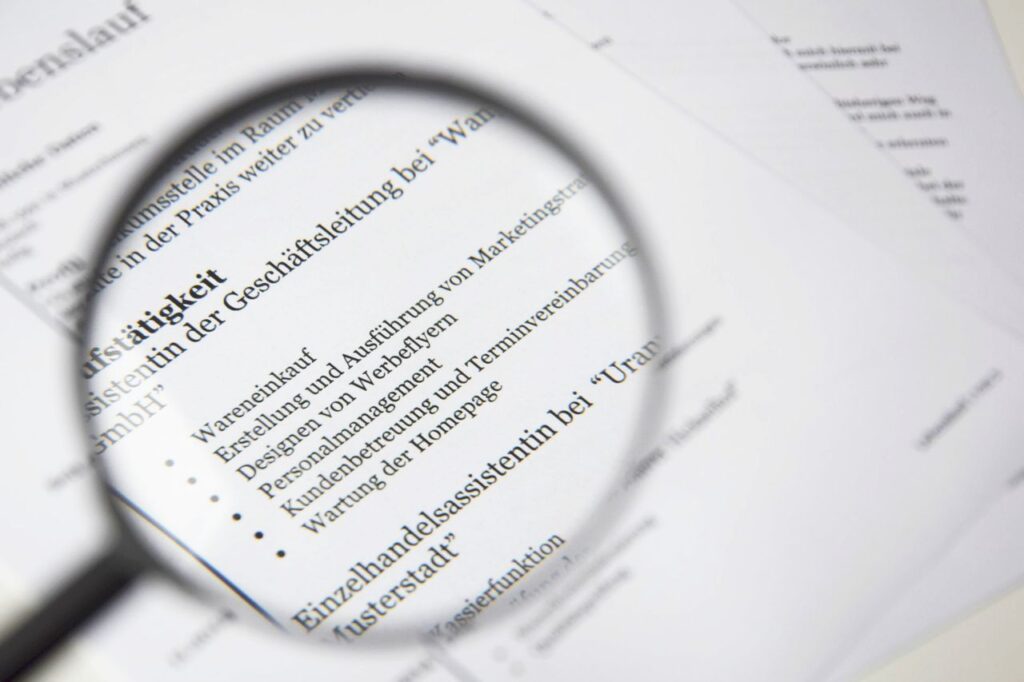
German job listing vocabulary includes a core set of phrases that appear repeatedly across industries. Knowing these terms lets you extract the relevant information quickly without needing to translate every sentence from scratch.
Here are some of the most frequently used phrases and what they actually mean:
- abgeschlossenes Studium: a completed university degree
- mehrjährige Berufserfahrung: several years of professional experience
- selbstständiges Arbeiten: the ability to work independently
- Teamfähigkeit: the ability to work well in a team
- verhandlungssichere Deutschkenntnisse: German skills at a negotiation-level (very high proficiency)
- gute Englischkenntnisse: good English skills (often B2 level or above)
- schnelle Auffassungsgabe: the ability to grasp new concepts quickly
- strukturierte Arbeitsweise: a structured, organized approach to work
- attraktives Gehaltspaket: an attractive salary package (usually means they won’t tell you the number upfront)
Many of these phrases appear in almost every German job ad regardless of the sector, so learning them once pays off across hundreds of future applications.
How do German job ads signal the required language level?
German job ads signal language requirements through specific descriptive phrases rather than referencing CEFR levels directly. The most common terms are Grundkenntnisse (basic knowledge), gute Kenntnisse (good knowledge), sehr gute Kenntnisse (very good knowledge), and verhandlungssichere Kenntnisse (negotiation-level proficiency), with the last being the highest expectation.
Here is a rough mapping of these phrases to CEFR levels:
- Grundkenntnisse: A1 to A2 (basic, everyday phrases)
- gute Kenntnisse: B1 to B2 (independent user, can handle most situations)
- sehr gute Kenntnisse: B2 to C1 (confident, fluent communication)
- verhandlungssichere Kenntnisse: C1 to C2 (near-native, suitable for complex negotiations)
- Muttersprache: native speaker level
If a listing says verhandlungssicheres Deutsch, that is a strong signal that German is central to the role and you will be expected to communicate at a high level in meetings, written correspondence, and client interactions. Gute Deutschkenntnisse, on the other hand, suggests that B2 proficiency is likely sufficient to get started, especially if the team environment is internationally oriented.
What’s the difference between ‘Muss-Kriterien’ and ‘Wunsch-Kriterien’ in a job listing?
Muss-Kriterien (must-have criteria) are non-negotiable requirements that every applicant needs to meet. Wunsch-Kriterien (wish criteria or nice-to-haves) are preferred qualifications that strengthen your application but are not required. Not meeting a Muss-Kriterium will typically disqualify your application, while missing a Wunsch-Kriterium rarely will.
German job ads don’t always label these categories explicitly, but you can identify them by the language used:
- Phrases like Sie haben (you have), Sie verfügen über (you possess), or Voraussetzung ist (a requirement is) usually indicate Muss-Kriterien
- Phrases like idealerweise (ideally), wünschenswert (desirable), von Vorteil (an advantage), or gerne auch (we also welcome) signal Wunsch-Kriterien
A practical rule: if you meet around 70 to 80 percent of the listed requirements and all of the clearly mandatory ones, it is usually worth applying. German employers often write ambitious requirement lists, and many hiring managers expect candidates to grow into some of the listed qualifications on the job.
How do you match your application documents to a German job ad?
To match your application documents to a German job ad, mirror the language and priorities of the listing in your cover letter and CV. Pick up the specific terms the employer uses for skills and responsibilities, and reflect them back in your own wording. This signals clearly that you understand the role and meet the expectations described.
Here is a step-by-step approach:
- Highlight the Muss-Kriterien in the job listing and make sure each one is addressed somewhere in your application
- Use the same vocabulary the employer uses, for example if the ad mentions Projektmanagement, use that exact word rather than a synonym
- Structure your cover letter (Anschreiben) to follow the logic of the job ad: start with why the role interests you, then address the key requirements, then close with availability and motivation
- Adapt your CV (Lebenslauf) to emphasize experience directly relevant to the listed tasks
- Include a photo on your German CV, as this is still standard practice in Germany and expected by most employers
German employers tend to value precision and professionalism in application documents. A generic CV sent to ten companies without adjustment is far less effective than a carefully tailored one sent to three.
What German language skills do you need to work in Germany?
The German language skills you need to work in Germany depend on the role and industry. For most office-based and client-facing positions, B2 level German is the realistic minimum. For roles in international companies or tech, B1 may be sufficient if English is the working language. For public-sector jobs, healthcare, or legal roles, C1 or above is typically required.
Beyond the formal language level, employers in Germany value specific practical skills:
- Written communication: drafting professional emails, reports, and documentation in German
- Verbal communication: participating in meetings, giving presentations, and handling phone calls
- Reading comprehension: understanding contracts, internal guidelines, and official correspondence
- Workplace vocabulary: knowing industry-specific and administrative terminology
If you are currently at A2 or B1 and targeting roles that require B2, the gap is bridgeable with consistent study over several months. Focusing on professional and workplace German, rather than just conversational topics, will accelerate your progress significantly.
How lingoni helps you prepare for applying for jobs in Germany
Understanding a German job advertisement is one thing. Having the language skills to back up your application is another. That is where we come in.
With lingoni’s German online course, you can build the language foundation you need to apply for jobs in Germany with confidence. Here is what the course gives you:
- Structured lessons from A1 to B2, covering reading, writing, listening, and speaking
- Vocabulary training that includes professional and everyday German relevant to work life
- Milestone Tests at the end of each level so you can verify your progress before moving on
- The option to skip ahead if you are already at an intermediate level, so you are not wasting time on material you already know
- Preparation support for official exams like Goethe, telc, DSH, and TestDaF, which many employers and visa processes require
Whether you are starting from scratch or pushing from B1 to B2 to meet a specific job requirement, our course is designed to help you make real, measurable progress at your own pace. Start learning today and get closer to the German level that opens the right doors for you.