
Can your German language level affect your salary negotiations?
If you’re living or working in Germany, you’ve probably wondered whether investing time in improving your German actually pays off financially. The short answer is yes. Your German language level can directly influence how much you earn, how confidently you negotiate, and how far you advance in your career. Here’s what you need to know.
Does your German level really affect your salary?
Yes, your German proficiency level has a measurable impact on your salary in Germany. Employers in German-speaking countries consistently value language skills when setting compensation, especially for roles that involve client contact, teamwork, or management. Professionals who can communicate fluently in German are often considered for higher-responsibility positions, which naturally come with better pay.
This is particularly relevant in 2026, when Germany continues to attract large numbers of international professionals. The job market is competitive, and language ability is one of the clearest ways to differentiate yourself from other candidates with similar technical qualifications. A software developer who can hold meetings, write reports, and negotiate in German is simply more valuable to a German employer than one who cannot.
Beyond hiring decisions, language proficiency affects day-to-day performance. When you can communicate precisely, you have fewer misunderstandings, build stronger working relationships, and project more confidence. All of these factors contribute to how your employer perceives your value and, eventually, what they are willing to pay you.
Which German proficiency levels do employers care about most?

Most German employers look for at least B1 level German for roles that involve regular communication, with B2 being the threshold for professional fluency in most industries. At B2, you can understand complex workplace discussions, write formal emails, and participate in meetings without significant difficulty. For senior or client-facing roles, C1 is often expected.
Here is a practical breakdown of what each level means for your career:
- A1 to A2: Useful for basic daily life tasks, but rarely sufficient for professional roles in Germany. Most employers will not count this as a workplace skill.
- B1: The minimum level for many entry-level or trade positions. You can handle routine tasks and simple conversations, but complex discussions remain challenging.
- B2: The most commonly required level for professional employment. At this level, you can work independently in German across most industries.
- C1 and above: Expected in legal, academic, medical, or senior management contexts where precise, nuanced communication is required.
For most internationally mobile professionals, reaching B2 is the most practical goal. It opens significantly more doors than B1 while remaining achievable within a realistic timeframe with focused study.
How much more can you earn with better German skills?
While exact figures vary by industry and role, professionals with strong German language skills in Germany typically access a broader range of positions, negotiate from a stronger position, and face less competition than those with limited German. Language proficiency is not a salary multiplier on its own, but it removes barriers that directly limit earning potential.
Consider the practical differences:
- Professionals with limited German are often restricted to international teams or English-language roles, which represent a smaller slice of the overall job market.
- Fluent German speakers can apply for the full range of available positions, including those in German-owned companies that rarely advertise in English.
- Bilingual professionals are often seen as more adaptable and promotable, which matters when salary reviews come around.
In sectors like engineering, finance, healthcare, and logistics, where Germany is a global leader, being able to operate fully in German is not just a bonus. It is often what separates candidates who get promoted from those who stay in place.
How can you use your German skills in a salary negotiation?
You can use your German language skills as a direct argument in salary negotiations by framing them as a business asset rather than a personal achievement. If your German allows you to serve German-speaking clients, lead local teams, or reduce the company’s reliance on translation, that has real financial value to your employer.
Here are some concrete ways to bring language skills into a negotiation:
- Quantify the value: Think about what your German skills actually save or enable. Can you handle client calls that would otherwise require a German-speaking colleague? Can you manage supplier relationships directly? Make that concrete.
- Reference your certification: If you hold a formal qualification such as a Goethe, telc, or TestDaF certificate, mention it. Certified proficiency is more credible than a self-reported level.
- Connect it to your role: Tie your language ability to specific responsibilities in your job description. If communication in German is part of your role, your ability to do it well is a performance argument.
- Use German in the negotiation itself: If appropriate, conducting part of the negotiation in German sends a clear signal. It demonstrates rather than claims your ability.
Salary negotiations are ultimately about demonstrating value. Language skills are one of the clearest ways to show that you bring capabilities your employer would otherwise have to hire or train for separately.
What’s the fastest way to improve your German for work?
The fastest way to improve your German for professional use is to combine structured grammar and vocabulary learning with regular speaking practice in realistic, work-relevant contexts. Passive consumption alone, such as watching videos without active recall, builds familiarity but not fluency. You need consistent practice that forces you to produce the language, not just recognize it.
Practical steps that make a real difference:
- Start with your current level: If you already have some German, do not repeat beginner content. Take a placement or milestone test to identify exactly where you are and build from there.
- Focus on professional vocabulary early: General German is useful, but industry-specific terms and workplace phrases will serve you faster in a job context. Prioritize vocabulary that appears in your field.
- Practice speaking regularly: Reading and writing are important, but speaking in German is what most professionals find hardest under pressure. Small group conversation practice with a qualified instructor makes a significant difference.
- Set a concrete target level: Aiming to reach B2 gives you a clear milestone to work toward. Structured courses that progress from A1 to B2 help you track real progress rather than drifting through random content.
How lingoni helps you improve your German for your career
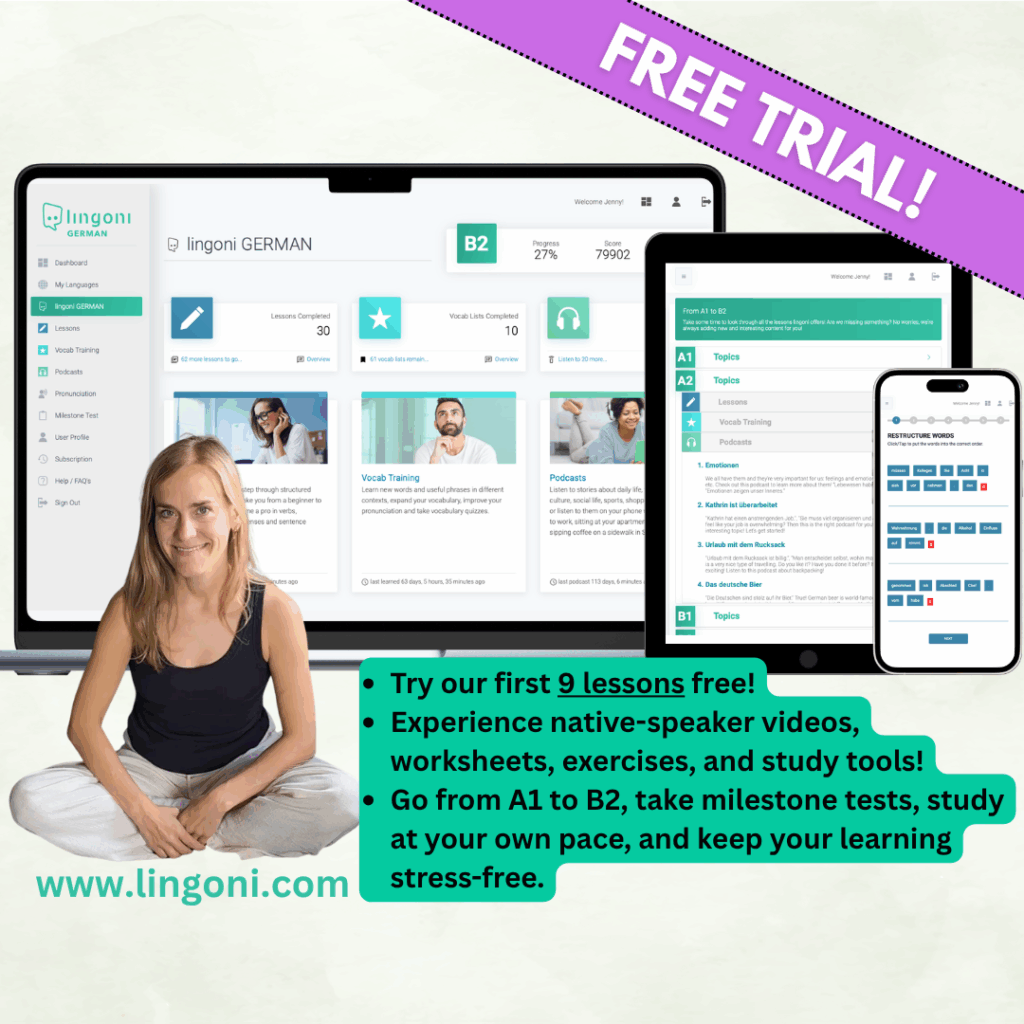
We built lingoni specifically for learners who want structured, measurable progress. Our German online course takes you from A1 to B2 through video lessons, worksheets, podcasts, and interactive exercises delivered by qualified native speakers. If you already have some German, you can take a Milestone Test to skip straight to your current level rather than repeating content you already know.
Here is what you get with lingoni:
- Structured progression through all levels from A1 to B2, with Milestone Tests at the end of each level to unlock the next
- Video lessons, podcasts, and interactive exercises covering reading, writing, listening, and pronunciation
- Preparation material for official exams including Goethe, telc, DSH, and TestDaF
- Live online group courses and private lessons for focused speaking practice in small groups of up to 10 students
- Flexible self-paced learning so you can fit study around work and other commitments
If improving your German is part of your career plan for 2026, the most important step is simply to start at the right level and stay consistent. We make both of those things straightforward.
Related Articles
- How do you decode a German job advertisement before applying?
- How do you switch jobs in Germany without losing your visa status?
- How do you talk about your qualifications in German during an interview?
- What Is the Best Way to Learn German Online?
- How Many Hours Does It Take to Learn Conversational German?